
For those of a certain age and mindset, Mystery Science Theater 3000 is a cultural icon. Here is a great recap of its history from Wired Magazine.
For those of a certain age and mindset, Mystery Science Theater 3000 is a cultural icon. Here is a great recap of its history from Wired Magazine.
Pharmaceutical giants Novartis and GSK announced a large swap in business units on Tuesday, resulting in both companies becoming significantly more specialized — reversing their decades-long traditional strategies of greater diversification across product lines. The Wall Street Journal has more than half a dozen articles about the news and what it might mean for the industry.
- Swiss giant Novartis, in the middle of a strategic rethink after an acquisition binge by its previous chairman, Daniel Vasella, agreed to buy GlaxoSmithKline’s high-margin oncology unit for $14.5 billion. That deal value would rise to $16 billion if certain development milestones are met.
- Novartis will sell its lower-margin vaccines division to GSK for $5.25 billion. The business, which relies on scale, is a better fit for GSK, and slims down the world’s ranks of big vaccine makers from five to four.
- Novartis will also sell its animal-health division to Eli Lilly for $5.4 billion.
- Finally, GSK and Novartis will create a joint venture, majority owned by GSK, for its consumer business—essentially those drugs that can be bought over the counter, creating a new giant in that business. The combined companies will have revenue of about $11 billion, and include household names like Excedrin and Panadol.
Focusing on core competencies, gaining efficiencies of scale, greater negotiating power and increasing competition for clinical trial patients were all mentioned as reasons for the changes at both companies. While the companies are becoming more specialized, they are pursuing somewhat opposite strategies. Novartis is consolidating around more risky high margin business lines, while GSK is taking a lower margin, high volume approach. Novartis does still own a significant generics business, however. It’s not clear how that unit figures into its strategy.
Clearly the thinking is that diversification across a wide range of product lines and disease areas is now less optimal. Analysts expect that other firms will respond. Merck, for example, is already considering selling off animal drugs and over-the-counter medicines. Pfizer is rumored to be interested in acquiring Astra Zeneca, possibly for that company’s early stage immunotherapy drugs to bolster its oncology pipeline. It will be interesting to see if other firms also consolidate into more limited product types and/or disease areas.
Unfortunately, pursuing economies of scale likely means another round of post-merger layoffs will hit the industry again, possibly as early as this year.
Virtual reality interactions with 3-D CAD models, followed by laser-based metal sintering 3-D printing. Really cool stuff. SpaceX is using these tools to build their next generation reusable launch system. Elon Musk is Tony Stark. Or is it the other way around?
Friday SpaceX had a successful launch of a Dragon cargo capsule, and what looks like promising results from a controlled splashdown test of booster landing capability.
Check out this video of the most recent land-based testing of the Falcon 9R:
Really cool stuff.
“Economics is organized common sense. Here is a short list of valuable lessons that our beautiful subject teaches.”
1. Many things that are desirable are not feasible.
2. Individuals and communities face trade-offs.
3. Other people have more information about their abilities, their efforts, and their preferences than you do.
4. Everyone responds to incentives, including people you want to help. That is why social safety nets don’t always end up working as intended.
5. There are tradeoffs between equality and efficiency.
6. In an equilibrium of a game or an economy, people are satisfied with their choices. That is why it is difficult for well meaning outsiders to change things for better or worse.
7. In the future, you too will respond to incentives. That is why there are some promises that you’d like to make but can’t. No one will believe those promises because they know that later it will not be in your interest to deliver. The lesson here is this: before you make a promise, think about whether you will want to keep it if and when your circumstances change. This is how you earn a reputation.
8. Governments and voters respond to incentives too. That is why governments sometimes default on loans and other promises that they have made.
9. It is feasible for one generation to shift costs to subsequent ones. That is what national government debts and the U.S. social security system do (but not the social security system of Singapore).
10. When a government spends, its citizens eventually pay, either today or tomorrow, either through explicit taxes or implicit ones like inflation.
11. Most people want other people to pay for public goods and government transfers (especially transfers to themselves).
12. Because market prices aggregate traders’ information, it is difficult to forecast stock prices and interest rates and exchange rates.
* * *
Here’s the (very brief) original text, from his 2007 Berkeley graduation speach. You can read more about Sargent and his Nobel Prize-winning work here. Hat tips to utopiayouarestandinginit, and marginalrevolution.
3-D printers are expected to grow into a $5 billion market over the next few years. Annually, printer shipments are projected to increase by 95% annually through 2017, by which time over a million units will ship per year. More than two thirds of them will be purchased by consumers.
What will the world be like when millions of customers have their own 3-D printer?
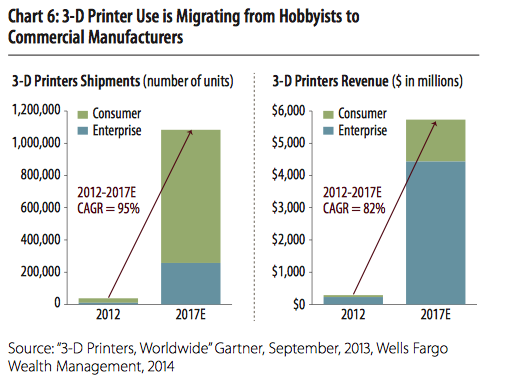 For more insights into 3-D printing and other evolving opportunities in technology, you can read this report from Wells Fargo.
 Interesting chart of the top 15 large pharma & biotech firms ranked by market capitalization. Note the resemblance to a power-law distribution (or exponential, really). If business outcomes are distributed like this, why would employee performance be normally distributed?
Data from Yahoo Finance.

Secure communications and reliable authentication are vital in a hyper-connected world. That’s why the Heartbleed security hole is a big deal. In case you haven’t heard about it, the short version of the story is that last week a security hole was discovered in OpenSSL software, a tool for managing encrypted communications between a web server and your browser. The Heartbleed bug allows a hacker to target the server and pull small random chunks of unencrypted data out of memory. If the hacker does this a lot — say 100,000 times or more, there’s a good chance they can grab passwords or read the private key of the server. Not good.
Estimates are that roughly 17 percent or of web servers use OpenSSL, so the bug was common, but not everywhere. Google and Yahoo had the bug, but Apple and Microsoft did not. Most banks were not affected either. For affected sites, the solution is to change your password — but after the hosting server has been patched. Fortunately many, but not all, affected servers have already applied the fix (click here for a list of affected sites). It should be pointed out that so far there is no indication of any user accounts actually being hacked, but the potential threat is serious. You can read this column by James Lynn at Forbes for more details on how to protect yourself.
If you’re interested in analyzing your blog traffic, but don’t know how to get started, check out Mack Collier’s comprehensive post on beginner blog analytics.
I’m in the process of migrating my old blog into this new location, and doing a little pruning at the same time. Stay tuned for updates…
 MechanizedIntelligence