The Mythical Man-Month

I recently read one of the classic books on management, “The Mythical Man-Month: Essays on Software Engineering” by Frederick Brooks.  It’s a quick read, and Brook’s observations are just as relevant today as they were when the book was first published in the 1970’s (the most recent edition was revised in the 1990’s).

One key takeaway: Project timelines are often dependent on a sequential tasks, each of which take a certain amount of time to complete, no matter how many people are thrown at the problem.  Projects can only be broken down into so many independent tasks, and many times you can’t proceed to a subsequent step until you solve the current problem, the timeline for which is often independent of resources deployed.  Hence the title referring to a commonly used, yet artificial and often misleading unit of work.  A hypothetical 100 man-month software project almost certainly can not be completed by 100 programmers all working simultaneously.  Put more humorously, 9 women can’t make a baby in one month. 

A related corollary is Brook’s Law:  “Adding manpower to a late software project makes it later”.  As new staff on any project (not just software!) need to be brought up to speed, trained, and project tasks need to be divided among additional participants, the projects actually slows down even further.

Other great tidbits:

  • For a typical software project Brooks recommended that you should allocate 1/3 time to planning, 1/6 to coding, 1/4 to testing individual components, and 1/4 time to testing the assembled product.
  • Always do a pilot project.  The chances are high that you’ll need to do two versions anyway, once you uncover all the things you missed or incorrectly designed on the first pass.  So you may as well plan for the first attempt to be a positive learning experience that informs the final version.  Can you say Healthcare.gov?
  • Flow charts are typically useless.  They take up a ton of space with boxes and arrows.  Better to simply list well-labeled steps in a process and link them logically.  Skip the superfluous graphics.
  • “Self-documenting” code or physical projects are tremendously useful — keep all the important explanations, specifications or comments tightly associated with the code, project documents or even physical objects that need them.  Don’t create (or worse, re-create) redundant or isolated documentation removed from where it’s needed.
  • Project leaders should take detailed notes for their own use, and edit them (or have someone else edit them) to make them interpretable for the rest of the team.  The resulting documents can become an official record of decisions made, design decisions, and an incredibly useful collection of background information.  I myself have often used this technique over the years, taking my notes or web bookmarks and turning the contents into a user guide, technical notebook or collection of tools.

That’s just some of the highlights; there’s lots more!

Posted in Management | Tagged , , , , | 1 Comment

Windows virtual computing services for the masses

20131115-135334.jpg
Well, it’s not quite free software, but Amazon has just announced “WorkSpaces“, a $35 per month complete Windows virtual computing service for your phone, tablet, or laptop. While the price may have to come down some more for widespread adoption, and I’m sure there are still some security or performance issues remaining, the writing is on the wall. Organizations small or large just don’t need to manage IT services — whether internal or outsourced — any more.

Data Scientists, and mission-critical IT specialists (with or without internally developed software) will still be really valuable. IT-savvy employees? Absolutely vital. But internal vanilla desktop support IT? Completely gone.

photo credit: yahoo finance

Posted in Innovation, Management | Tagged , , | Leave a comment

Spectacular View of Saturn

Check out this amazing photograph (actually a composite of 141 images) of the Saturn ring system, taken from the post “The Day the Earth Smiled”.  Being backlit by the sun, the planet itself is mostly black, except for the faint reflection of the ring systems on the Northern hemisphere.  The blue outermost E ring is the collection of icy particles ejected from the geysers on Enceladus.  If you squint, you can see that moon’s tiny white dot between 8 and 9 o’clock:  

Backlit rings of Saturn

Backlit rings of Saturn

To get the full details, follow this link to the original 9000 x 3500 pixel image produced by the Cassini spacecraft team.  Not only can you see Saturn’s rings and several other moons in all their glory, but when you zoom in you can see that the inner planets Mars, Venus, and Earth have also had their portraits captured:

7699_18472_1_earth

Earth as seen from the far side of Saturn

Posted in Fun Science | Tagged , , , , , , , | 1 Comment

If you want efficient and effective R&D, get your mix of solution shops and production shops right

I had the good fortune to attend a series of seminars by Clayton Cristensen last Spring.  One conceptual framework that Clay described is the three basic types of businesses, and I think it has a lot of relevance for Pharma R&D organizations.

There are three fundamental types of businesses: production shops, solution shops, and facilitated networks*.  The first two are most relevant for R&D.  Production shops are value-adding process businesses; for example, manufacturing or food service.  Such businesses take inputs and transform them into higher value outputs using regular, well-defined, processes.  Standardization is key, and it’s important to run at high capacity utilization. Production shops have to be paid/evaluated per unit of output (given the right level of quality).  In Pharma R&D, production shops would be things like HTS groups, sequencing facilities, routine DMPK, or perhaps protein production.

In contrast, solution shops are like consulting or design firms, where flexibility, creativity, and a lot of redundant capacity and capabilities are all required.  In a solution shop you need a lot of different tools (because you never know what’s going to be thrown at you), and you need deep subject matter expertise.  Solution shops have to be paid on a fee for service or FTE basis, and evaluated on the quality of the overall deliverable.  In Pharma R&D, solution shop activities would be assay development work, developing novel animal models, working on new target identification.

Big problems result if you don’t understand what type of business you’re in or if you try to manage/compensate a solution shop as if it were a production shop, or vice versa.  Paying a fixed fee per widget doesn’t work for a solution shop, because the amount of work needed to complete each project can vary wildly.  The amount of time needed for each project is also variable.  If you try to skimp on tools, or technology, or training & learning in a solution shop, you’ll get in trouble.  Conversely, letting production shop staff buy one of every type of tool, or use any old process they feel like is not a successful strategy.  Production shops need to be efficient, and standardized.

A research and development organization needs the right mix of solution and production shops.  Parts of R&D can be managed in a production shop manner — with standardization, high capacity utilization, etc.  But solution shop management also needs to be embedded appropriately within the entire process. In fact, most production shops need associated solution shop expertise for troubleshooting or — even more importantly — for innovation.

—-

*facilitated network businesses are things like insurance, telecommunications, or Ebay.  Membership fees are the appropriate type of compensation.

Posted in Fixing Big Pharma Research, Management | Tagged , , , , , , | Leave a comment

The Age of Free Software is Upon Us

OS X Mavericks is Free

Apple just announced that their latest version of OS X, “Mavericks” is available now, for free.  Both Apple and Google now offer free operating software, subsidized by hardware, advertising, or other software sales.  Can Microsoft continue to charge for Windows?

With free OS (OS X, Chrome) and free productivity (Google Docs, iLife, iWork) software, along with powerful customizable free scripting (Python) and statistical/numerical analytics (R) tools, it seems that all the basic software needed for research and business are free.  And let’s not forget other free software, like free 3-D design or mapping tools.

It will be interesting to see what software people will still pay for.  Certainly the latest and greatest games, must-have apps, and hard-to-replicate specialty software.  But the era of the big expensive (at least to the consumer) OS and productivity suite is over.

(Photo credit:  WSJ Apple Event Live Blog)

Posted in Innovation | Tagged , , , , , , , , , | 3 Comments

Kendrick Pond

Along the shore of Kendrick Pond, on a crisp Fall day in Massachusetts.

More Galleries | Tagged , , , | Leave a comment

Boston-Cambridge is THE Life Sciences Hub

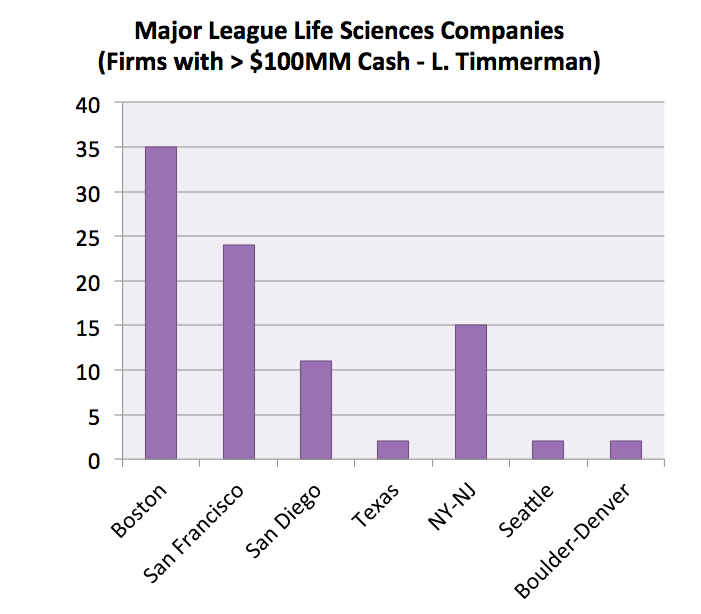
Luke Timmerman from Xconomy has published an analysis of where the major Life Sciences companies are located. Using the criteria of having $100 million in cash and short term assets as the definition of a major firm, his analysis highlights what many observers have been noticing anecdotally — the Boston-Cambridge cluster is hands down the largest and fastest growing innovative Life Sciences hub in the U.S. (and thus the world).  From 2003 to 2013, the number of major Life Sciences firms headquartered in Boston grew to 35, an astonishing growth rate of 192%. The next largest cluster, San Francisco, has 24 firms (growing 21% since 2003).  And Boston’s count of companies doesn’t even include the major big pharmaceutical research centers that have sprung up in the last decade, but with corporate headquarters located elsewhere.

Major LIfe Sciences Firms by Region

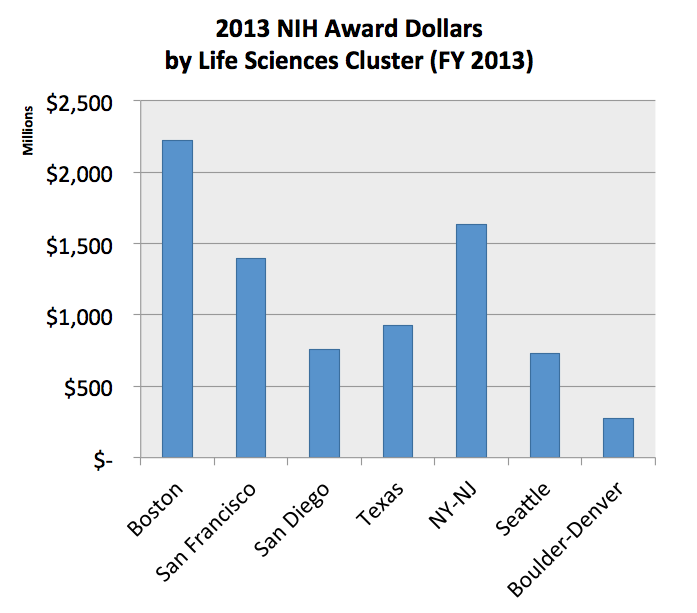
A major driver of life sciences innovation is academic research and here, too, the Boston metro area stands out.  I gathered the latest NIH grant award data, broken down by the metropolitan regions that Luke analyzed:

NIH Spending by Metro Region

Boston-Cambridge received NIH funding of $2.2 billion in 2013, more than any other region of the country.  On a per capita basis, Boston biomedical research stands out even more:

Per Capita NIH Dollars

Obviously there’s more to driving Life Sciences innovation than just NIH funding.  Hospitals and universities, angel investors, venture capital, the presence of a talented  workforce, and a critical mass of local companies all play a huge role.  Still, it’s tempting to think of a life sciences cluster like Boston as an engine that takes basic research and converts that input into breakthrough healthcare products.  Looking at it that way, an important question would be just how efficient are biotech hubs at creating innovation?  One metric would be the annual NIH spending per major Life Sciences firm:

NIH Dollars per Firm

If you think of NIH dollars as investments in the pharma/biotech industry, Boston-Cambridge, San Francisco, and San Diego stand out as being the three regions that are the most efficient — all three host about one major life sciences firm for every $60-70 million in regional annual NIH funding.  Considering that each one of these firms have at least $100 million in cash alone, and are worth many billions of dollars in aggregate, it looks like it’s been a pretty good investment.

Will the Boston area’s growth continue?  The number of construction cranes on the Cambridge skyline would indicate yes, but the ecosystem is surprisingly delicate.  Some of these firms may not succeed.  Rents are rising, the metro area is quite congested, and of course the fiscal mess in Washington threatens the long term health of biomedical research funding.  For now, however, the boom (bubble?) is on.

Posted in Innovation, Research | Tagged , , , , , , , | 6 Comments

Average Is Over: Powering America Beyond the Age of the Great Stagnation

What happens to the U.S. economy when the entire trucking industry converts to self-driving vehicles?  What does it mean for the medical profession if IBM’s Watson is available 24/7 to diagnose your illness?  When an entire college or graduate school curriculum in any subject — taught by the best professors in the world — is available on line for free?

In his new book, Average Is Over: Powering America Beyond the Age of the Great Stagnation, Tyler Cowen has some thought provoking things to say about the nature of work and jobs in an age of ubiquitous intelligent systems and robots.  Tyler predicts a world of mechanized intelligence or augmented thinking where all of human knowledge is available for searching at any moment and everything is measured and evaluated.  In this future bi-modal global economy, the middle class as we know it disappears. Some successful humans leverage their ability to automate many physical and mental tasks and reap tremendous rewards, but many others fall behind — and no one is average.

Posted in Uncategorized | Leave a comment

Fixing Big Pharma Research: Two Things about Restructuring

For a pharmaceutical company restructuring to be successful, senior management has to get two things right:

1)  Restructuring is a forward-looking process.  Management has to plan the new organization so that it is successful in the future. People, processes, organizations, buildings, or entire sites are retained on the basis of what they can accomplish going forward.  Such decisions are not made on the basis of past performance (except insofar as past performance is relevant to predict future performance).

2) The new organization has to become significantly more efficient, to achieve the same or better overall level of productivity.  Cutting expenditures by 20% means a new organization has to be at least 25% more efficient than the old one.  Cutting a unit’s headcount by 33% requires 50% more productivity from the remaining staff.

Bottom line:  A successful restructuring has to look forward, and it must create large increases in efficiency.  Sounds straightforward, but it is not easy.  As history shows…


Posted in Fixing Big Pharma Research, Management | Tagged , , , , , , | Leave a comment

Not your father’s yacht racing…

Congratulations to Oracle Team USA on winning their America’s Cup defense. When you think of the America’s Cup, if you think of this:

The_Yacht_'America'_Winning_the_International_Race_Fitz_Hugh_Lane_1851

…think again!

Posted in Innovation, Uncategorized | Tagged , , , , , | Leave a comment