More thoughts on drug company R&D productivity ranking

[updated]  Some comments I received on the previous post made me realize there was a more fundamental flaw in drug company R&D productivity rankings that should be highlighted. Drug discovery is by and large a high failure rate multistep process with a long and relatively uncoupled feedback loop.  (People with some knowledge of System Dynamics will immediately notice a similarity to Sloan’s Beer Game — a game not about drinking, but rather about the instability of supply chains with delayed feedback loops).

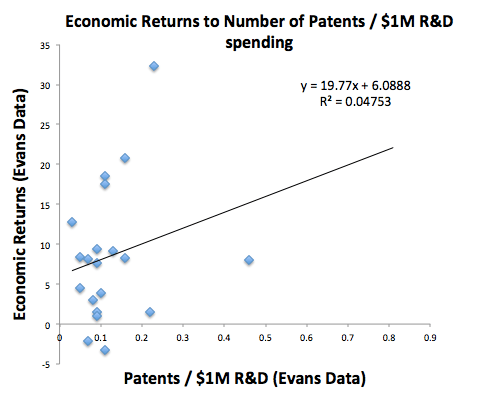
At every stage — target ID, target validation, hit finding, hit-to-lead, lead optimization, preclinical development, and the various phases of clinical development — anywhere between 50 and 90% of projects unexpectedly fail to progress (overall, 19 in 20 development projects fail).  These are projects that well-informed and highly trained experts predicted would be worth pursuing, based on large amounts of available data.  Yet they were wrong.  Given that historic behavior in the system, it is unlikely that there are any currently available intermediate R&D metrics that predict overall R&D productivity (as measured by final economic profits) in a meaningful way.  Numbers of patents, numbers of papers, numbers of projects, dollars spent per project, etc., etc.  Any intermediate metric will not be predictive.  Consider, for example, the following chart:
Economic Returns to # Patents / $1M in R&D

As a quick and dirty analysis, I’ve taken the Evans economic returns metric and replotted it as a function of the number of patents per $1M R&D spending for each drug company.  Naively, one might expect that the more patents produced per $1M in R&D spending, the more productive a drug company would be.  But that is not the case.  The right side outlier is Allergan, with an 8% return and 0.46 patents per $1M.  The top outlier is Celgene, with a 32% return and 0.23 patents per $1M.  Including these outliers, there is essentially no correlation between the efficiency of generating patents and economic outcome.  Most companies generate between 0.05 and 0.2 patents per $1M spent, with a wide range of economic return between -3 and 21%.

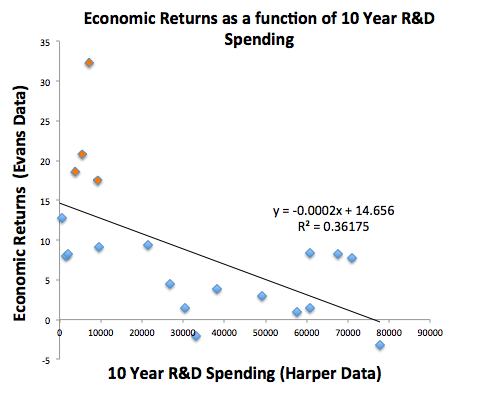
One can, of course, simply measure total R&D dollars spent or dollars per new drug and compare that to profit dollars out and catalog the historical economic productivity of each drug discovery company, or the industry as a whole.  But even this metric is not predictive.  Below I’ve merged some of Evans’ results with some data from an excellent analysis done by Matt Herper:
Economic Returns as a Function of 10yr R&D Spend

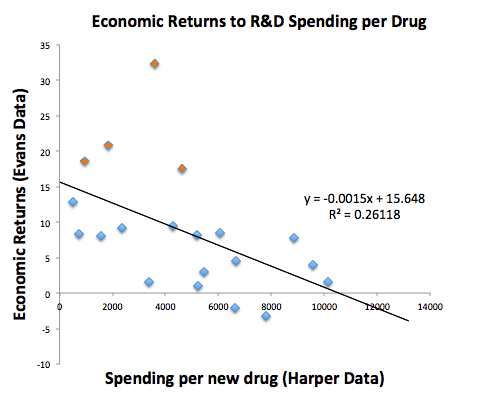
The top four data points in the upper left are Celgene, Gilead, Novo Nordisk and Shire. Even with those highly profitable biotechs* included in this data set, economic return does not correlate well (R squared = 0.36) with the total amount of R&D spending over the previous 10 years (the correlation is actually negative, and yes, Pfizer is the lower right outlier).  Remove them, and there is no correlation at all. Plotting dollars per drug on the x-axis makes the correlation even worse. (dollar amounts are in $millions, FYI):
Economic Returns to Per Drug Spending

Correlation plots for the patent-derived quality of innovation, rank of therapeutic area and internal bias metrics don’t look any better.

As we’re all acutely aware, in the last 20 years overall economic productivity of the Pharma industry has been on a strong downward trend, and R&D spending at the company level is not tightly coupled to economic success.  But, in addition, I’m pessimistic that there is meaningful predictive information on a more granular level.  I’d be curious to hear your thoughts.

____

* One lesson from those firms is that it can be especially profitable to re-purpose existing drugs, and that you don’t need to spend much in R&D to acquire products.  Of course someone else did have to pay for that R&D.

Posted in Fixing Big Pharma Research, Pharmaceutical Industry | Tagged | Leave a comment

Who’s The Best In Drug Research? 22 Companies Ranked Incorrectly

Matt Herper at Forbes has a post on new pharmaceutical research productivity data from Richard Evans, a former Roche executive and Wall Street analyst.  Evans calculates metrics such as (1) Economic Returns to R&D spending, (2) Patents / $1M R&D spend, (3) Average Relative Quality of Innovation, (4) Average Rank (by share of innovation) in Target Research Areas, and (5) Internal Bias Index.  It’s an ambitious attempt to quantify R&D productivity, and the data is though-provoking, but there are a lot of caveats.  Economic returns to R&D is the most accurate calculation, but can still be confounded by several factors, including sampling bias.  Young companies with single blockbusters look much more profitable.  The power law distribution of performance makes an older company with a bigger portfolio (with a longer tail of less lucrative products) look less productive, overall.  But small companies with non-block busters are likely to go out of business or be acquired, and so don’t show up in the data.

My main complaint, however, is that several of the parameters are derived from data on the number of patents and citations of patents. Unlike software or engineering patents which can be reasonably assumed to be more proportional to research productivity, I don’t think drug and therapeutic patents, publications and citations are at all necessarily proportional to R&D economic productivity.  The numbers of compound patents filed and issued can be quite variable, and target patents are quite often issued to academic centers, which aren’t included in the data.  Numbers of published papers and citations of course are highly variable (some companies have lenient rules for publications, some clamp down and limit publications), and often depend on the trendiness of a target or the ease at which multiple investigators can work on related projects yet still carve out publishable material. The citation data is also highly biased toward who is first to patent, but not necessarily who is getting the greatest economic benefit.  Coming late to the statin field, Liptor patents were probably not as highly cited as, say, Mevacor patents.

The internal bias index is particularly flawed in its logic.  Relying on more externally-derived programs is not a priori an indication of better R&D productivity, especially when that productivity is measured in units of patents and citations.  A more accurate metric would be the ratio of economic returns from internal vs. external sources, but all that would tell you is the relative value of internal vs. external R&D.  The total economic returns parameter is still the bottom line.

Posted in Fixing Big Pharma Research, Pharmaceutical Industry | Tagged , , | Leave a comment

Software is still eating the world

Russ Roberts has a new EconTalk podcast interview with Marc Andreessen that is worth a listen:

Marc Andreessen, venture capitalist and co-creator of the early web browser Mosaic, talks with EconTalk host Russ Roberts about how success in venture capital is more about winners that you missed and not losers that you backed. Other topics discussed include the rise of the developing world and the smartphone revolution, why Bitcoin is paving the way for innovative uses of the internet, an optimistic view of the future of journalism, changes in the healthcare system, and the future of education around the world.

One thing I remember clearly is Marc’s 2011 Wall Street Journal opinion piece, “Why software is eating the world.”  His thesis, which is even more true today, was that software had reached such a level of power and sophistication, and smart devices were so ubiquitous and networked that software would be able to augment or completely replace many existing bricks and mortar, people-intensive businesses.  Online banking and the disruption of the news media was just the beginning, with many more disruptive innovations to come.  Higher education, which is just starting to feel real pain from an out of control cost structure, may be next.

Oh, yeah, one other thing. As has been amply demonstrated, venture capital returns are power law distributed.  According to Marc, of the 4000 or so tech startups that get launched every year, 400 of those receive VC funding, and 60 of those funded make significant money.  In fact, the majority of returns come from just a handful of firms.  So, again, why would employee performance follow a bell curve?


Posted in Data Analysis, Innovation | Tagged , , , | Leave a comment

Apple and Google poised to enter the 3D printing market?

1122423-13710886152487078-Matt-Cilderman

Speculation has been building that Apple and Google might be gearing up to produce consumer 3D printers (along with other tech giants).  Indeed, analysts have been urging Apple to do so.

Apple, of course, was primarily responsible for the desktop publishing phenomena, and has recently filed for several 3D printing patents.  That, coupled with their extensive experience with high tech materials and complex manufacturing, makes a compelling argument for them to enter the market.  Google, meanwhile is getting into everything, whether or not they have existing expertise.  MakerBot and Cube have big head starts among consumers, but the market is about to get crowded.  And, as someone very successful once said, “you don’t want to be first to market, you want to be last.”

Posted in 3-D Printing, Innovation | Tagged , , , , | Leave a comment

Most Selective Colleges by State

Most Selective College by State

Each state is marked with the logo of the most selective college located within that state.

Posted in Data Analysis | Tagged , | 3 Comments

MakerBot launches a push-button consumer 3D-printer

MakerBot Mini

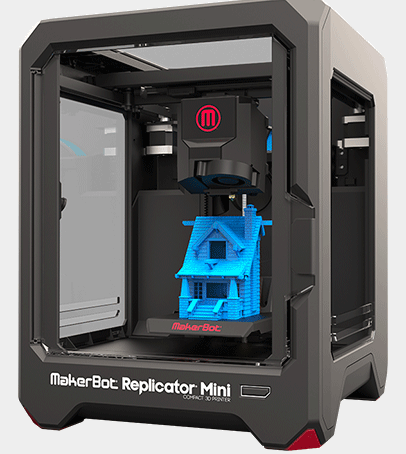
MakerBot‘s newest 3-D printer, the Makerbot Replictor Mini, started shipping yesterday.   Employing fast and easy “One Touch” 3D printing, the Mini is a cost-effective solution for small scale prototyping or teaching kids about creating and printing in three dimensions.  Makerbot also sells a small 3-D digitizer (seen below).  Together you can capture 3D models, edit and manipulate them on a computer, and print them using PLA plastic.   Total price tag is about $2,200 for both devices ($1375 for the Mini alone).  Not exactly pocket change, but I predict that quite a few schools buy these as teaching tools.

MakerBot Digitizer

Rumor has it that MakerBot will soon be partnering with companies to sell licensed 3-D models of favorite TV and movie characters, which you can print in your own home.

Posted in 3-D Printing, Innovation | Tagged , , , | 1 Comment

Pfizer raises its bid for AstraZeneca – one last time?

Over the weekend, Pfizer finally made an official offer for AstraZeneca,  by raising its bid to $119B (15% higher than the last, unofficial, offer), and increasing the cash portion of the deal from 33% to 45%.  AZ had a market cap of about $74B at the end of 2013, and about $80B right before the Pfizer offer became public, so the current offer is at a premium of about 50-60%.  Such an offer will be enticing to some shareholders, but is starting to look expensive, for a conventional acquisition.  Of course, this isn’t a conventional deal.  Stay tuned…

[update] AstraZeneca’s board quickly responded “no”, and by UK law Pfizer can’t officially raise their bid before the deal deadline.  After that passes, there is a 6 month window during which Pfizer can’t bid again. As a consequence, AZ’s shares are down more than 10% (and some of their investors aren’t happy with the board’s decision).

I don’t think Pfizer will give up that easily, however.

Posted in Pharmaceutical Industry | Tagged , , , | Leave a comment

FDA Drives Medical Innovation Overseas As 23andme Looks Elsewhere To Help People

Last Fall, the FDA blocked the personal genetic profiling offered by 23andMe, stopping the sale of the company’s home genetic testing kits in the U.S.  At the time TechFreedom issued a plea:

We haven’t all used 23andMe yet, but those of us who have know the real problem is that doctors themselves are behind the curve. When 23andMe sent us our results, we followed their advice: we asked our doctor to talk about them. Most doctors didn’t know where to begin. But the more of us ask, the more the medical profession is catching up: brushing up on genomics, taking the time to understand the site, and talking to us about our results and what, if anything, to do about them. By prompting such dialogue, 23andMe has sparked a revolution in how the medical profession uses genetic information.

We urge you not to short-circuit this revolution. Please trust us — and our doctors — to make responsible use of our own genetic information. Instead of hamstringing new technologies, the FDA should focus on educating doctors and patients about the benefits, and limitations, of genetic testing.

23andMe, fearing that the FDA will take years to evaluate the product, has given up on the U.S. for now and is looking to help people in overseas markets.  Keep in mind that 23andMe is providing your own personal genetic data that alerts you potentially interesting genetic variants.  The company strongly encourages customers to consult with their doctor for any additional testing and advice that might be warranted.  So it is not, technically, providing a diagnostic.  That said, widespread use of their inexpensive technology would be a great way to build awareness of genetic information and its limitations.  It could potentially provide a useful data set for further study, at a very low overall cost.  Well, perhaps in other countries, anyway.

Posted in Innovation, Science | Tagged , , | Leave a comment

Happy Mother’s Day

Happy Mother's Day

Mother’s Day is also Lilac Sunday at the Arnold Arboretum of Harvard University.  The Arboretum has 172 different varieties of lilacs (close to 400 individual plants) that put on quite a show around the second Sunday in May.

Posted in Photography | Tagged , , | Leave a comment

Pfizer is a shark that can’t stop feeding

20140508-003705.jpg

So says John LaMattina, a former head of research at Pfizer:

The only way for a shark to survive is to keep going forward. To maintain its leadership, Pfizer will again need to make a major acquisition in the next 4 – 5 years. Given Pfizer’s policy that a CEO must retire at age 65, this duty will likely fall to the 60 year old Read’s successor. Consider it a right-of-passage for a Pfizer CEO. Care to speculate as to what company would be a prime take-over target in 2019? Bristol-Myers Squibb? Lilly? Perhaps the unthinkable, Merck ? It will be fascinating to watch this play out. But given its size and commitment to internal R&D, this is Pfizer’s future.

LaMattina points out that Pfizer is so big, and needs so many new products to maintain its revenue (let alone grow!) in the face of patent expirations, that it has to make large acquisitions. History is littered with behemoths that tried a continuous acquisition strategy, but stumbled and died. Why would Pfizer be any different? This round with AZ is a bit special, since a huge tax arbitrage play will justify a large part of it. But in general what could fund this strategy for quite a few more years is the huge R&D expense that Pfizer can cut from each acquired pharma company, in addition to the usual operational synergies that come with big mergers. I hope I’m wrong, but Pfizer seems on track to become a much larger, relatively unleveraged version of Valeant (or is it the other way around?).

Posted in Pharmaceutical Industry | Tagged , , , , | Leave a comment