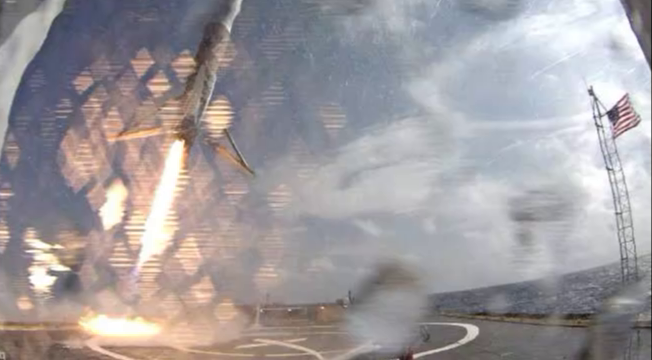
SpaceX Rocket Booster Landing — Close, But Not Quite

landing_0

CRS-6 Landing Attempt for Falcon-9 Rocket

Yesterday’s landing attempt for the SpaceX Falcon-9 booster almost succeeded.  The rocket came down on the robotic recovery ship, but had too much lateral velocity and tipped over.

Meanwhile, the main mission to resupply the International Space Station is on track for a Friday rendezvous.  The cargo-carrying Dragon capsule is also a recoverable vehicle (final landing is via parachutes, not rockets), and was successfully recovered on the last mission:

crs5_dragon_nest

SpaceX Dragon capsule recovered during mission CRS-5.

The next Falcon-9 landing attempt will be in June. Stay tuned.

Posted in Innovation, Space & Astronomy | Tagged | Leave a comment

History of Camera Sales, with Smartphones Included

chart

From Michael Zhang, writing at PetaPixel:

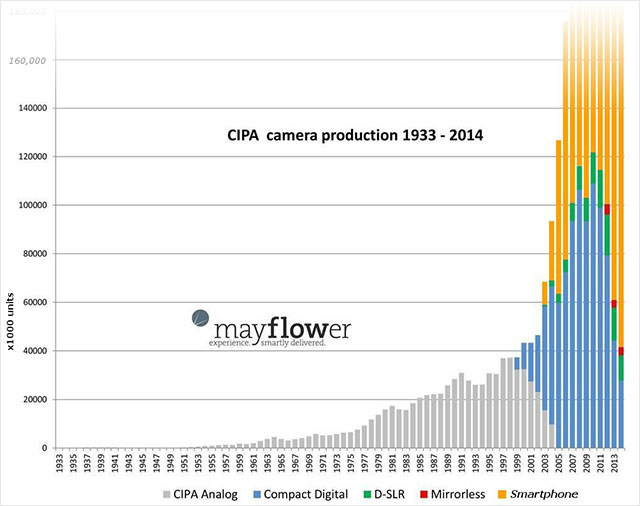
A few months ago, we shared a chart showing how sales the camera market have changed between 1947 and 2014. The data shows that after a large spike in the late 2000s, the sales of dedicated cameras have been shrinking by double digit figures each of the following years. Mix in data for smartphone sales, and the chart can shed some more light on the state of the industry.

Photographer Sven Skafisk decided to see what the same chart would look like with smartphone sales factored in. Here’s the chart he came up with using data from Gartner Inc. (The figures don’t include the sales of PDAs and “dumb phones”).

The chart is reproduced above. Recent smartphone sales are represented by truncated peaks on the right hand side —  Those off scale peaks are above 1.2 million per year and still rising fast. In other words, a gigantic explosion in the global availability of cameras, allowing for ubiquitous image and video capture, world-wide.

P.S. Here are a couple of additional facts: the number of photos captured each year has also been growing exponentially since the beginning of photography — digital took over film’s volume over the past decade or two — and 92% of smartphone users worldwide say that the camera is the most used feature on their phones.

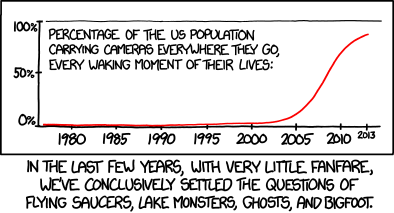
I’m reminded of one of my favorite xkcd cartoons:

settled

But in a much more serious example, this technology tidal wave made possible the capture of video footage of the murder of Walter Scott.  Let’s hope the spread of citizen cameras everywhere is a force for positive change.

Posted in Innovation, Photography | Tagged | Leave a comment

Fully Automated Airline Flights Are Already a Reality

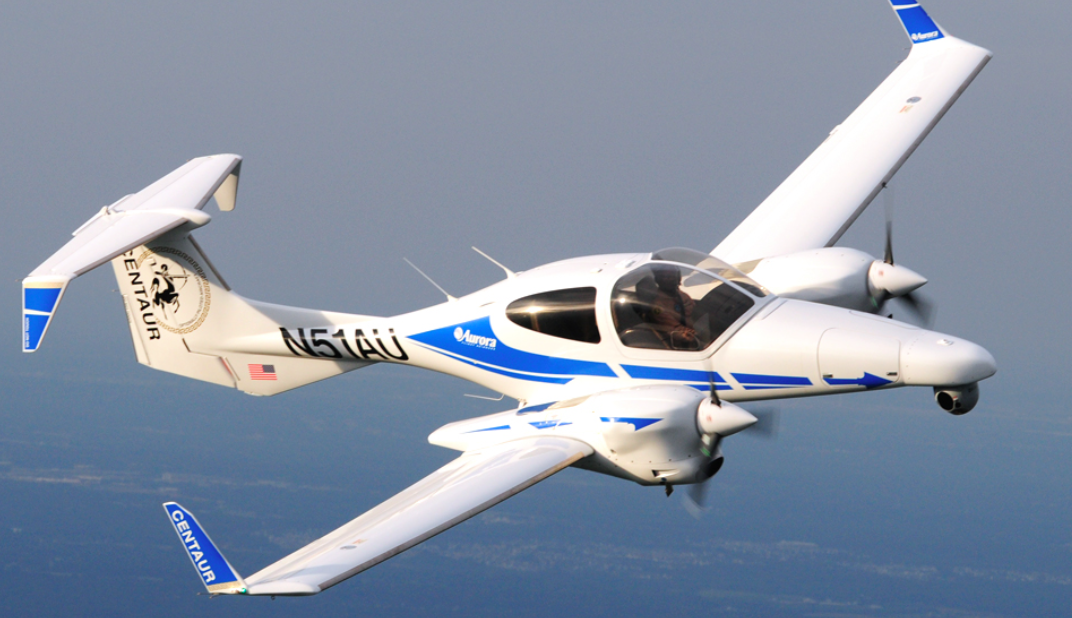
Centaur Optionally Piloted Aircraft

Centaur Optionally Piloted Aircraft

Apparently, large commercial airline pilots already spend less than 7 minutes actually controlling their plane, according to a recent survey.  Fully automated flight is pretty much already in place, including examples like the Centaur Optionally Piloted Aircraft.

The military has had pilotless drones for years, of course, and apparently there are now even auto collision avoidance systems on fighter jets that can take full control of the plane.  Moving to no pilots at all on commercial or even cargo flights may be a step too far, however.  A fighter pilot can eject, and a drone can be crash landed at relatively low risk to bystanders on the ground.  But a plane full of passengers (without parachutes!) is another matter.  Plus one — or better yet — two pilots can do a lot more troubleshooting a lot quicker than an AI system or remote pilot.  At least for now.

John Markof of the New York Times has interesting details and discussion.

Posted in Innovation | Leave a comment

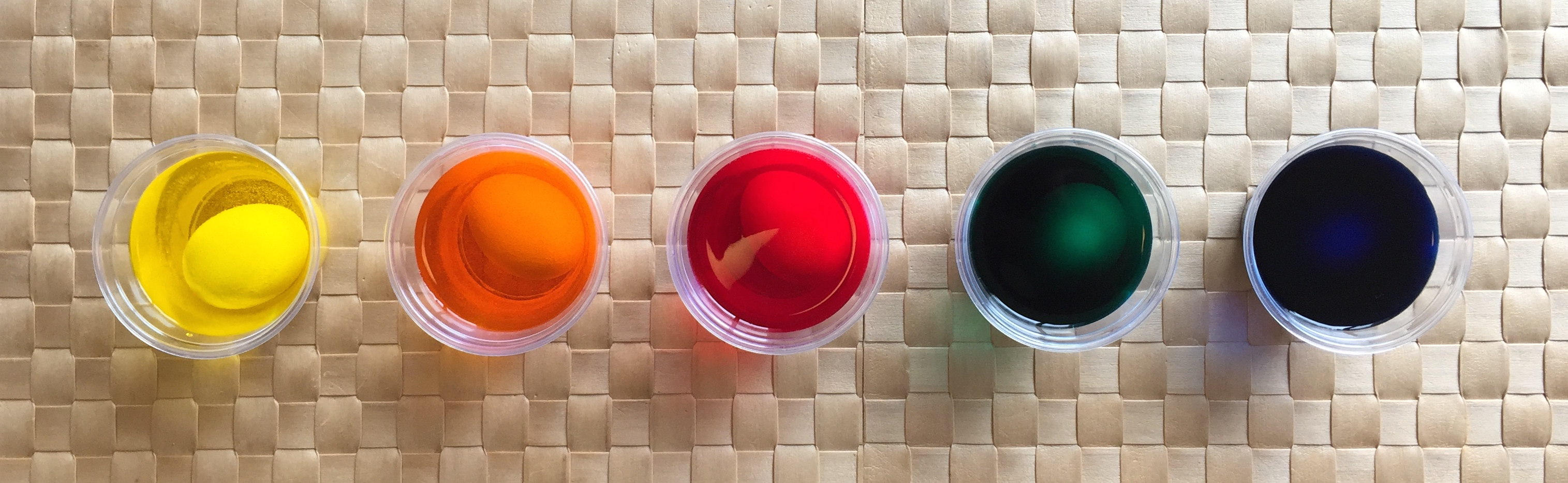
Happy Easter

EasterEggDyes

Posted in Photography | Leave a comment

3D-Printed Bionic Ants Work as a Terrifying Team

From Popular Mechanics, an article about 3-D printed bugs that work toward a common goal:

Ants are known for their selflessness, working collectively for the greater good of the colony in order to move giant crumbs up giant anthills. That’s also the case for BionicANTs, Festo’s new group of 3D-printed robotic ants. BionicANTs (ANT stand for Autonomous Networking Technologies) act like their biological counterparts, putting group goals ahead of individual interests so they can accomplish more complex work than they could do alone.

Like the industrious insects, BionicANTS can find and move objects that are bigger than their own bodies. Real ants do it by adhering to a strict caste system and communicating via pheromones, sound, and touch. Robotic ones do it with the help of stereo cameras on their heads to establish the location of nearby objects; chin grippers; optical sensors on their feet to read infrared lines on their floor; and a radio module for communication. The robotic ants are also outfitted with battery contacts on their antennas and piezo-ceramic bending transducers to move their legs. Most of each ant, including its outer electronic circuitry, is 3D-printed.

Read the whole thing and watch the video.  Pretty amazing, and somewhat scary, too.  See New Scientist for the original article.

Posted in 3-D Printing, Automation, Innovation | Tagged , | Leave a comment

New version of Microsoft Office for the Mac is on the way, but will it help the bottom line much?

After a long wait, a new Mac version of Microsoft Office is on the way.   There is a free downloadable preview version available from Microsoft, with the official release scheduled for some time in the second half of 2015.

Faced with increasing competition from Google Docs and other lightweight replacements for Office, Microsoft made Office free for mobile devices, and is heavily promoting the online service Office 365.  There are obvious advantages to a cloud based product with subscription pricing, but I wonder if this won’t end up further facilitating the move away from the laptop/desktop Office (certainly as a paid product, anyway).  After you’re comfortable with cloud based productivity, why keep paying for Microsoft Office (at least for the average consumer)?  Google and Apple have switched completely to free application software, but that’s still a key source of revenue for Microsoft.  Perhaps this is all part of a plan, but I’m still not sure how Microsoft will adapt to a world of free software.

Posted in Information Technology | Tagged , | Leave a comment

Boston breaks seasonal snowfall record

DSC04043

Residents in the Boston-Cambridge area can take some small comfort in the fact that this winter has in fact broken the record for most snowfall in a season.

“Superbowls, World Series’, Stanley Cups, and snowfall records,” Mayor Martin J. Walsh tweeted. “We are truly a title city. There will be no parade.”

And yes, the stockade fence in the background of that backyard photo is six feet tall.

Posted in Boston-Cambridge, Fun Science | Tagged , | Leave a comment

3-D printer for small molecules opens access to customized chemistry

burke_marty150217-128 hh web

Automated Synthesizer for Small Molecules

As reported on the Howard Hughes Medical Institute’s web site:

Scientists led by Martin Burke, an HHMI early career scientist at the University of Illinois at Urbana-Champaign, used a single automated process to synthesize 14 distinct classes of small molecules from a common set of building blocks. Burke’s team envisions expanding the approach to enable the production of thousands of potentially useful molecules with a single machine, which they describe as a “3D printer” for small molecules. Their work is described in the March 13, 2015, issue of the journal Science.

According to Burke, the highly customized approach that chemists have long relied on to synthesize small molecules is time consuming and inaccessible to most researchers. “A lot of great medicines have not been discovered yet because of this synthesis bottleneck,” he says. With his new technology, Burke aims to change that. “The vision is that anybody could go to a website, pick the building blocks they want, instruct their assembly through the web, and the small molecules would get synthesized and shipped,” Burke says. “We’re not there yet, but we now have an actionable roadmap toward on-demand small-molecule synthesis for non-specialists.”

While “3D printer” is a bit of an exaggeration, conceptually this is a very powerful technique.  The method (which, it can’t be over emphasized, is still in it’s infancy) takes molecular building blocks with connectors on either end and then “prints” them out in any combination you specify.  The real breakthrough is more along the lines of the digitization of chemistry, and a better analogy might be the way DNA synthesis is done currently.  DNA synthesis used to be done by hand in a chemistry lab but is now done in incredibly high throughput on automated synthesizers.  By commoditizing and miniaturizing small molecule chemical synthesis in a similar way, vast amounts of synthesis could be done very fast and very cheaply.

One limitation of the method is the small scale of the reactions, but scientist are working on solutions for that, too.

Posted in 3-D Printing, Innovation, Science | Tagged , | Leave a comment

New Horizons probe images a full orbit of Charon around Pluto

Charon around Pluto

The images are still grainy, but NASA’s New Horizons probe is beginning to film Charon traveling in its orbit around Pluto.  Follow this link to see the animated version!

Posted in Space & Astronomy | Tagged , , , | Leave a comment

Dwarfed by Big Pharma, Biotech by the numbers

From Bruce Booth’s blog, three charts that illustrate the extent to which large pharma companies dwarf small biotechs.  In total, small biotech firms only spend an estimated $6 billion a year on research and development, approximately equal to Pfizer’s annual R&D budget.

From an investor’s point of view, there is a lot of opportunity in biotech — small companies have a lot of room for growth on the way to being established companies!  But for the biopharmaceutical industry as a whole  — which is suffering from a lack of in-house productivity — large scale in-licensing from biotech does not look like it can provide more than a small fraction of what pharmaceutical firms need to fill their pipelines.

Posted in Biotech, Pharmaceutical Industry | Tagged | Leave a comment