

First color movie of Pluto and Charon, courtesy of NASA and Johns Hopkins Applied Physics Laboratory. Pluto has a distinct reddish tint, while Charon is more grey.
First color movie of Pluto and Charon, courtesy of NASA and Johns Hopkins Applied Physics Laboratory. Pluto has a distinct reddish tint, while Charon is more grey.
There are two common Lean metrics for determining just how efficiently equipment is being utilized, and both are relevant for scientific research operations. Equipment covers a wide variety of capital items, including automation platforms (liquid handlers, integrated robotics, etc.), scientific instruments (e.g. microscopes, cytometers, mass spectrometers), or even entire specialized facilities (like a biologics pilot plant). All of these can be analyzed using this methodology.
The first metric is Overall Equipment Effectiveness, or OEE. The second is Total Effective Equipment Performance, or TEEP, which builds on OEE (both acronyms are a lot easier to remember than their full definitions!).
OEE = Availability x Performance x Quality
Where:
Availability = Available Time / Scheduled Time
Performance = (Parts Produced x Ideal Cycle Time) / Available Time
Quality = Good Units / Units Started
Available time is scheduled time minus any outages or other maintenance time. Performance measures how closely the number of parts produced (or experiments run) matches the time that was available divided by the ideal cycle time. Quality measures what fraction of runs is successful.
TEEP adds another factor, the extent to which you are fully loading your equipment.
TEEP = Loading x OEE
Where:
Loading = Scheduled Time / Calendar Time
Loading is the time the equipment was scheduled for use divided by calendar time. If equipment is scheduled for use 8 hours a day, 5 days per week (40h/168h), loading is about 24%.
For a modern manufacturing facility, the target for TEEP is 24 h x 365 d operation (loading = 100%), with world-class OEE of 85%. OEE of 85% reflects availability, performance, and quality all of about 95% each. Generally, local operations managers try to achieve high OEE, while more senior managers drive better TEEP through increasing and smoothing product demand and efficiently managing the facilities footprint. In Lean, smoothing is an important concept and key goal for operations. Interestingly, OEE and TEEP have qualities of geometric averages, and thus variability is more easily detected.
The real strength of this kind of analysis is that it helps a manager figure out where the best opportunities for improvement are. For example, let’s say you manage a sequencing facility that has more orders than you can handle (loading is high), excellent up time (high availability), low numbers of failed runs (high quality), and really efficient processing times (runs completed x ideal cycle times = available time). In such a case the only significant way to get extra capacity is to buy more machines. On the other hand, if an operation has problems with quality, down time, or excessively long run times, the component OEE parameters will identify which areas need attention and, importantly, how much of a percentage gain you can hope to achieve by improving each parameter. Monitoring OEE and TEEP and their component parameters thereby facilitates better management by focussing attention on performance parameters that will have the greatest impact.
Bill Reichert’s top ten management lessons from the US Navy.
h/t Stacie Sherwood & Jeff Griffin via LinkedIn.
From Fierce Biotech, news that the “unending game of global reorganization in biopharma R&D is continuing” with a new move by Takeda to close several vaccine operations around the U.S. in order to concentrate R&D in “the hot Boston/Cambridge, MA hub“

A team of scientists has developed a new blood test that simultaneously detects the presence of circulating antibodies to more than 1000 strains of 206 known human viruses. In essence, the test profiles an individual’s lifetime history of viral infections.
Published in Science, the method is technically complex, but cheap to administer — requiring only a tiny drop of blood. Using a combination of microarray technology, phage display and DNA sequencing, known viral peptide epitopes (the parts of viruses targeted by human antibodies) are used to capture existing antiviral antibodies. Such antibodies are only present if a person was previously infected. Testing previously could only be done for only one viral strain at a time, but now can be accomplished in one fell swoop.
A group of 569 people of varying ages and geographical location was profiled. Subjects were found to have been exposed to about 10 virus species on average, though the number varied from patient to patient. At one extreme, two individuals were found to have been infected by at least 84 species. Interestingly, the study found that some epitopes were remarkably common across the population, suggesting that for some viruses, there were common “public epitopes” elicited over and over again.
The new methodology opens up exciting possibilities for studying the effects of viral infections on causation of human diseases such as cancer, multiple sclerosis, and type I diabetes.
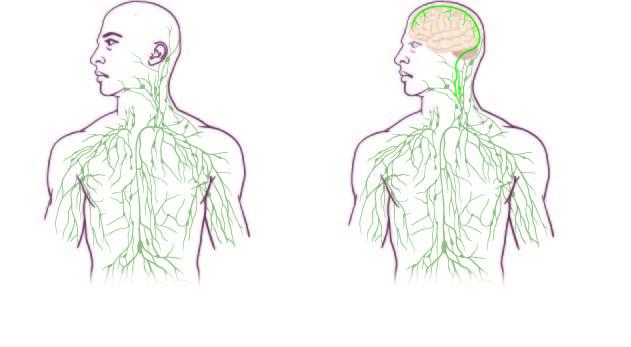
A striking paper published in Nature shows that the lymphatic system is in fact connected to the brain. This has huge implications for diseases that are linked to dysfunctional immunological responses, like multiple sclerosis, Alzheimer’s, and autism.
The authors were “searching for T-cell gateways into and out of the meninges, [and] we discovered functional lymphatic vessels lining the dural sinuses.” In other words, the brain does in fact have a functioning lymph system.
From the press release (the hype may well be justified):
Diagram from University of Virginia Health System.
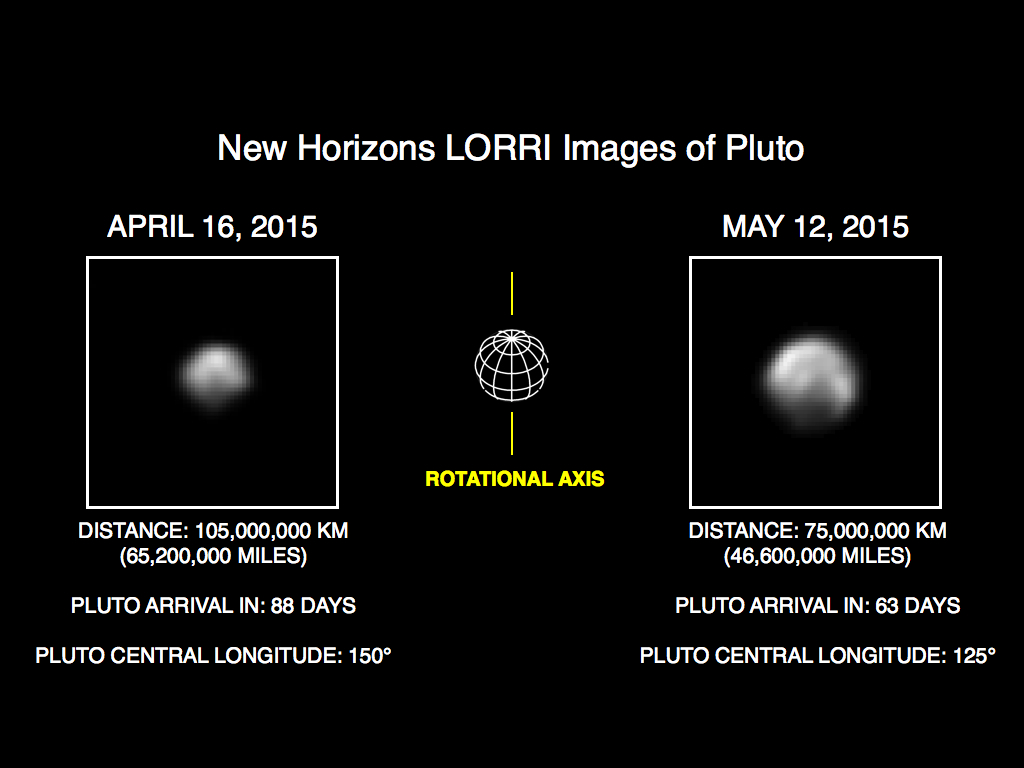
The New Horizons space probe is seeing more as it approaches Pluto. The spacecraft is closing in at the rate of 750,000 miles per day, increasing image clarity at an accelerating rate:
“By late June the image resolution will be four times better than the images made May 8-12, and by the time of closest approach, we expect to obtain images with more than 5,000 times the current resolution,” said Hal Weaver, the mission’s project scientist at the Johns Hopkins University Applied Physics Laboratory (APL) in Laurel, Maryland.
Stay tuned.
From space.com, a nice post recapping the last attempt to land a SpaceX Falcon 9 booster on an ocean-going drone platform:
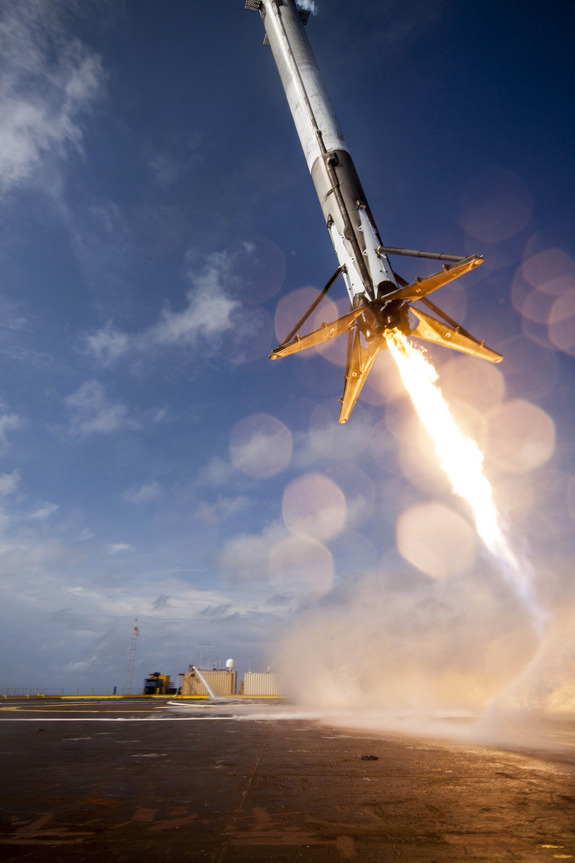
Over at io9.com there are some other interesting comments, too.
In keeping with this week’s space theme, three other noteworthy events:
Today NASA’s Messenger probe orbiting Mercury finally ran out of propellant and, as planned, crashed into the planet surface, ending its historic 11 year mission.

Last image of Mercury received from the Messenger space probe
The spacecraft traveled more than six and a half years before it was inserted into orbit around Mercury on March 18, 2011. The prime mission was to orbit the planet and collect data for one Earth year. The spacecraft’s healthy instruments, remaining fuel, and new questions raised by early findings resulted in two approved operations extensions, allowing the mission to continue for almost four years and resulting in more scientific firsts.
One key science finding in 2012 provided compelling support for the hypothesis that Mercury harbors abundant frozen water and other volatile materials in its permanently shadowed polar craters.
Data indicated the ice in Mercury’s polar regions, if spread over an area the size of Washington, would be more than two miles thick. For the first time, scientists began seeing clearly a chapter in the story of how the inner planets, including Earth, acquired water and some of the chemical building blocks for life.
A dark layer covering most of the water ice deposits supports the theory that organic compounds, as well as water, were delivered from the outer solar system to the inner planets and may have led to prebiotic chemical synthesis and, thusly, life on Earth.
On Wednesday, Jeff Bezo’s Blue Origin had a successful test launch of the New Sheppard reusable vertical takeoff & landing spacecraft. After a brief suborbital mission, the capsule parachuted safely back to earth.

From Reuters’ coverage:
Blue Origin is among a handful of companies developing privately owned spaceships to fly experiments, satellites and passengers into space. Like Virgin Galactic, a U.S. offshoot of Richard Branson’s London-based Virgin Group, and privately owned XCOR Aerospace, Blue Origin is eyeing suborbital spaceflights, which reach altitudes of about 62 miles (100 km), as a stepping stone to orbital flight.
[Meanwhile] Boeing and privately owned Space Exploration Technologies, or SpaceX, both of which have financial support from NASA, are skipping suborbital flight and building space taxis to ferry crews to and from the International Space Station, which flies about 250 miles (418 km) above Earth.
Lest we take space exploration for granted, here’s an example of just how difficult it actually is: On Tuesday a Progress resupply mission to the International Space Station had a communication/propulsion failure of some sort. The vehicle is not responding to propulsion commands, and appears to be spinning out of control, though it is transmitting video. It will likely renter the atmosphere sometime in the next two weeks with the unfortunate loss of 6000 pounds of food, fuel and other supplies.

Still image of Progress 59 launch
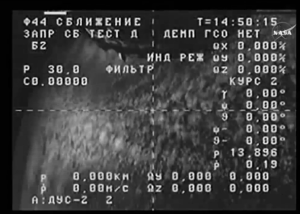
Click to watch launch and orbital video

For the first time, images from NASA’s New Horizons spacecraft are revealing bright and dark regions on the surface of faraway Pluto – the primary target of the New Horizons close flyby in mid-July.
The images were captured in early to mid-April from within 70 million miles (113 million kilometers), using the telescopic Long Range Reconnaissance Imager (LORRI) camera on New Horizons. A technique called image deconvolution sharpens the raw, unprocessed images beamed back to Earth. New Horizons scientists interpreted the data to reveal the dwarf planet has broad surface markings – some bright, some dark – including a bright area at one pole that may be a polar cap.
See the Johns Hopkins Applied Physics Laboratory web site for full coverage of New Horizons, including an animated series of photos.
 MechanizedIntelligence