Automated Investment Portfolio Management Goes Mainstream

Discount brokerage firm Charles Schwab has announced that it will soon start a new free automated investment advisor service, “Schwab Intelligent Portfolios.”

The Finance Buff is covering the topic:

Like the other so-called robo-advisors such as Betterment and Wealthfront, Schwab’s computer algorithm is going to suggest and manage a portfolio of ETFs for you. The minimum is only $5,000. You can have IRA and taxable accounts. You can fund the account with recurring deposits. It’s going to be automatically rebalanced. Once you have $50,000 or more, you also get automated tax loss harvesting.

The big difference is that Schwab’s service is going to be FREE: no trading commission, no advisory fee, no service fee. You just pay the normal expense ratios on the underlying ETFs. And it comes with Schwab’s brand name and its customer service.

All of these firms are using modern portfolio theory and behavioral asset management techniques to design customized asset allocations for individual investors.

What’s noteworthy is that Schwab is a mainstream retail brokerage house, not an online startup.  Plus their service will be free (Betterment and Wealthfront aren’t free, but they do charge relatively modest fees).  Will this mark the beginning of widespread automated investment management for the retail investor?  If the experience of Bettement and Wealthfront is any guide, yes. Betterment was founded in 2008 and now has $800 million in assets under management, while Wealthfront “grew from nothing to $1 billion in 2-1/2 years“.  Lots of investors are fearful of making investment mistakes, and this is one way to make sure your portfolio is managed in a professional, unbiased way.  Of course it should be pointed out that if an algorithm can manage your portfolio, so can you.  But for many retail investors — those who feel they aren’t knowledgeable or disciplined enough — these services will be popular.

Posted in Innovation, Investing | Tagged , , , , | Leave a comment

Happy Halloween

JackOLanterns

Posted in Photography | Tagged | Leave a comment

Leading technologist professor Clay Shirky bans use of personal electronics in his classroom

Clay Shirky is a leading technologist who teaches theory and practice of social media at NYU.  He is an advocate and activist for social technology, crowd-sourcing and the free culture movement, but is now asking the students in his Fall seminar to refrain from using laptops, tables, and phones in class.

I came late and reluctantly to this decision — I have been teaching classes about the internet since 1998, and I’ve generally had a laissez-faire attitude towards technology use in the classroom. This was partly because the subject of my classes made technology use feel organic, and when device use went well, it was great. Then there was the competitive aspect — it’s my job to be more interesting than the possible distractions, so a ban felt like cheating. And finally, there’s not wanting to infantilize my students, who are adults, even if young ones — time management is their job, not mine.

Clay goes on to describe how year after year, his students seem to become more distracted, and when he occasionally tells them “lids down” it is like a breath of fresh air in the room.    Clay uses Jonathan Heidt’s metaphor of the elephant as a useful illustration.  According to Heidt, the mind is like an elephant of emotions being ridden by a rider of the intellect.  The rider can see and plan ahead, and together rider and elephant can accomplish amazing things.  But the emotional elephant is far more powerful, and can react skittishly and be driven off course — or worse, stampede.  If intellect and emotion are in conflict, usually the elephant wins.

What makes this intellectual-emotional battle especially one-sided is that device operating systems and social media are designed to grab your attention and distract you, by manipulating your emotional urge to stay connected and not miss out on something really exciting.  Multitasking does not help, in fact it fools people into thinking they’re being more productive than they are, and it interferes with long term memory.

People often start multi-tasking because they believe it will help them get more done. Those gains never materialize; instead, efficiency is degraded. However, it provides emotional gratification as a side-effect. (Multi-tasking moves the pleasure of procrastination inside the period of work.) This side-effect is enough to keep people committed to multi-tasking despite worsening the very thing they set out to improve.

Evidence like this has been building for a while, but what really changed things for Clay was the growing understanding that the distractions also affect all the other students nearby!

The final realization — the one that firmly tipped me over into the “No devices in class” camp — was this: screens generate distraction in a manner akin to second-hand smoke. A paper with the blunt title Laptop Multitasking Hinders Classroom Learning for Both Users and Nearby Peers says it all:

We found that participants who multitasked on a laptop during a lecture scored lower on a test compared to those who did not multitask, and participants who were in direct view of a multitasking peer scored lower on a test compared to those who were not. The results demonstrate that multitasking on a laptop poses a significant distraction to both users and fellow students and can be detrimental to comprehension of lecture content.

So Clay is now asking his students to refrain from using any technology in class.  His full essay is a must read for anyone who teaches — or hosts meetings where the laptops and smart phones are active.  Personal electronic devices and social media are incredibly powerful, but you need to use them or not.  And if you are using them, then you can’t be doing something else well at the same time.  Unless that something else doesn’t actually employ your brain.  Like texting and driving, there’s no safe middle ground.

Posted in Education, Information Technology | Tagged , , | Leave a comment

Isaac Asimov on Generating New Ideas

Here’s a never before seen essay on creativity by Isaac Asimov, recovered from the files of Arthur Obermayer and reprinted in MIT’s Technology Review.

The main recommendation: use informal meetings as a way to educate participants in new facts, and fact-combinations, in new theories and “vagrant thoughts”. Keep meetings small (five people or less), and the atmosphere informal, relaxed and permissive. Let no one person dominate.

Think of The Eagle pub with Watson and Crick having a pint in 1953. Or think lunch time at the MRC Laboratory of Molecular Biology in the 60’s and 70’s. In those sorts of environments, connections between previously disparate facts (or people) will be made… and new ideas will follow.

Posted in Innovation | Tagged , | Leave a comment

Assorted Links

U.S. Treasury clampdown on tax inversions continues to ripple through industry: The AbbVie and Shire merger may be off.. The EU’s investigation of Apple’s Irish tax breaks probably had an influence as well.

Shenzhen tech ecosystem disrupts Samsung and other global tech giants.

Another healthcare worker in Dallas infected with Ebola. If this Charlie Foxtrot continues, we’re going to be losing US healthcare workers faster than US patients. That’s a problem.

Related: Responding to Ebola takes an entire community. Administrators are pointing out that if the scale of this really expands, we will bankrupt hospitals.

Posted in Uncategorized | Leave a comment

Measure cosmic rays with your cell phone

VERITAS_array

Instead of large ground based Cherenkov radiation telescopes, use cell phone cameras to detect cosmic rays!

CRAYFIS (Cosmic Rays Found in Smartphones) is a cool new project that plans to use the world-wide array of existing smartphones to detect low energy particles produced by high energy comic ray collisions in the atmosphere.

From the project website:

When cosmic rays strike the atmosphere, they produce a huge number of lower-energy particles in an an extensive air shower, which can stretch to many kilometers across. The very high-energy cosmic rays produce the largest showers, but unfortunately they are also the rarest. Only a detector with large surface area can observe these mysterious particles.

The current state of the art is large-scale arrays of custom-designed dedicated detectors. To see the highest-energy cosmic rays, we need a very large detector array of exisiting commodity hardware: the smartphones in everyone’s pockets.

Modern smartphones contain high-resolution cameras with digital sensors which are sensitive to the particles in a cosmic ray shower. They know where they are (GPS) and can upload their data (wi-fi). Most importantly, there are 1.5 billion active smartphones spread across the planet. Essentially, this detector has already been deployed; all that is missing is the app to collect the data.

Apparently the app uses your cell phone camera sensor’s chip while it’s idle, and works on both Android and iOS phones.  However, the infrastructure to aggregate of all the data is still in beta testing.  In the meantime, you can sign up to be notified when a full scale rollout of the free app is possible.

 (image source: http://en.wikipedia.org/wiki/Cosmic_ray)

Posted in Innovation, Space & Astronomy | Tagged | Leave a comment

Super-Resolution Imaging

Lightsheet image

Today’s 2014 Nobel Prize in Chemistry has been awarded to three pioneers in the area of super-resolution imaging:  Eric Betzig, Stefan Hell, and W. E. Moerner.  Super-resolution imaging is a set of techniques that allows light microscopes to detect incredibly small features within tissues and cells.  The resulting resolution is much more detailed than what’s achievable with conventional diffraction-limited microscopy.  Cell Press has some cool slide shows and background information on the topic.  And there’s a neat SnapShot on the various types of light microscopy.

image source: Cell press

Posted in Fun Science, Innovation | Tagged , | Leave a comment

Beware Institutional Mimicry

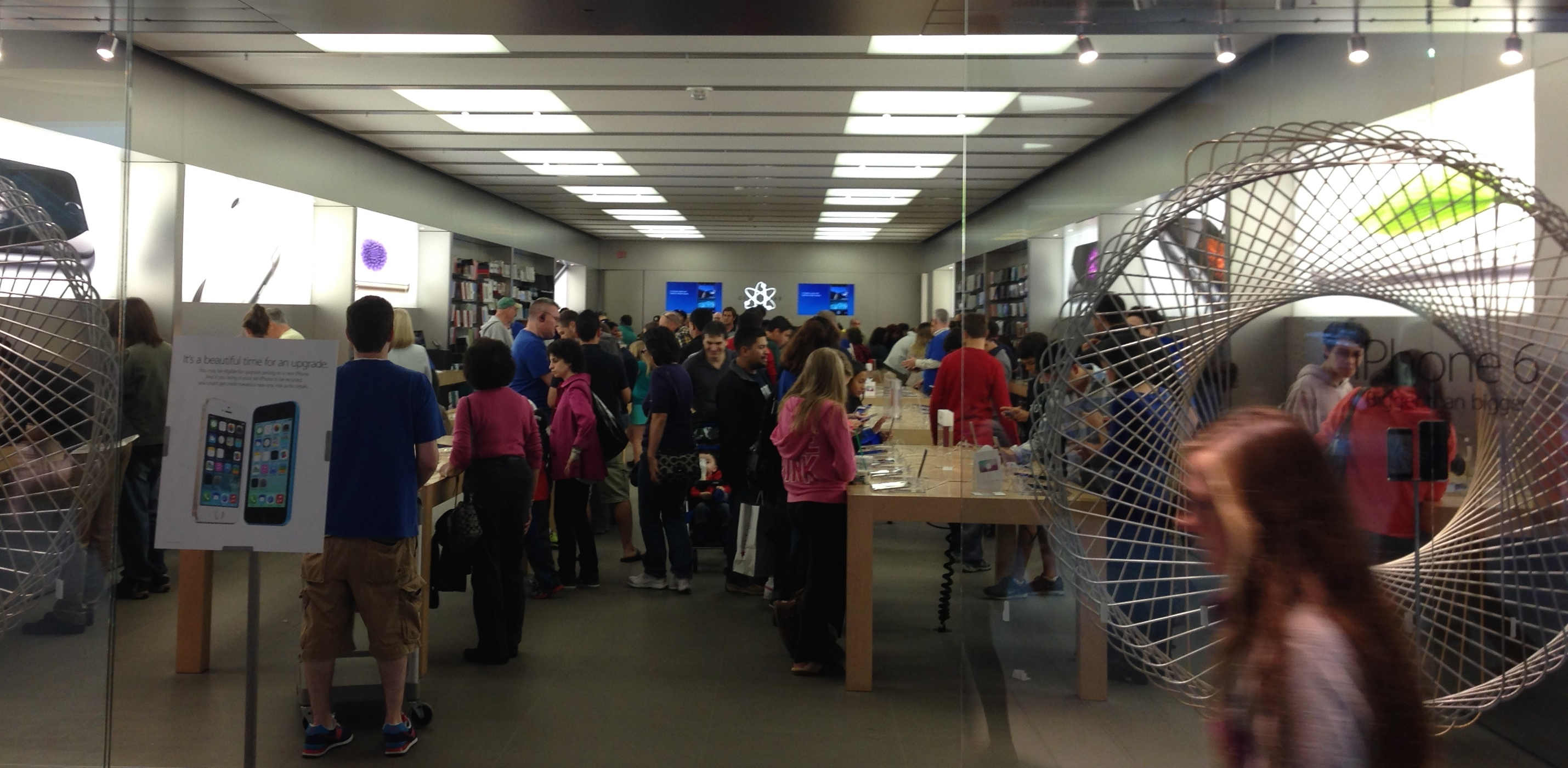
Apple Store Oct 4Microsoft Oct 4

One of the most common management pitfalls is the trap of institutional mimicry. Companies that are falling behind, or otherwise need to reinvent themselves, look around at the competition and other relevant benchmarks, and try to copy “what works”.  But instead of copying the real capabilities or underlying successful strategies that lead to success, they copy things that are easy to observe and easy to replicate — at least on the surface.  The result is wasted money, with little to show for the effort  (see also:  cargo cult).

Take, for example, Microsoft.  Finding itself falling behind in the area of consumer sales and brand recognition of their devices, Microsoft decided they needed fancy retail stores, just like Apple’s.  Their stores look just like Apple’s:  Gleaming hardwood floor, check.  Double rows of overhead lighting and big colorful product images on the walls, check. Lots of devices on sleek tables, check. Helpful sales staff in colorful T-shirts, check.  But as you can see from the images above, on a typical day Apple’s store is packed and buzzing, while Microsoft’s store is quiet, with less than one tenth the customers.  What’s going on here?

For Apple, their retail stores in and of themselves aren’t a differentiating capability.  They are in fact the outward manifestation of a more fundamental underlying capability — Apple’s unrelenting focus on providing a superb user experience, and their philosophy of unmatchable design excellence.  Creating that customer experience in physical stores was a logical extension of their core strategy.  In other words, the stores are a marker for Apple’s winning strategy, not the strategy itself.  Microsoft just hasn’t had that consumer focus in the same way as Apple.  There was no Steve Jobs at Microsoft, nor a Jony Ive.  There was instead Bill Gates and Steve Ballmer, and now Satya Nadella.  Completely different fundamental corporate strategies.

Other examples of institutional mimicry include adopting Six Sigma or Lean tools, but not actually having a culture committed to operational excellence and continuous improvement.  Or hosting lots of employee “innovation jams”, but not actually having an organizational structure that allows innovative projects to survive.  Think of your own institution (corporate, academic or government).  Is it currently adopting a “winning strategy” from somewhere else?  If so, are you getting the fundamentals right, or are you just copying the window dressing?

Posted in Fixing Big Pharma Research, Management | Tagged , , | Leave a comment

What it’s like to drive a 3D-printed car

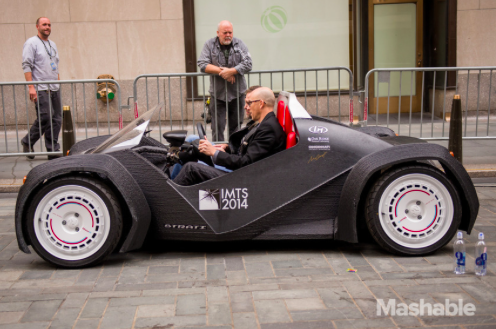
3D printed car

Mashable has Lance Ulanoff’s first person account of what it’s like to drive a 3-D printed car: “singularly awesome!”  The Strati, made by Local Motors, has leather seats, Bridgestone Battlax (motorcycle) wheels, a small Renault Twizy electric motor and a 120 pound battery, but only 49 total parts.  The largest part is, in fact, the 3-D printed plastic body.

Even though this is a printed car, it doesn’t give the impression of a kit or even cheaply made automobile. The leather-clad steering wheel feels solid in my hands. There’s a tiny dash display for speed and nestled to the left and somewhat behind the steering wheel is a set of three buttons with the letters DNR. D is drive, N is neutral and R is reverse. I note blinker controls on the wheel column, but not a lot else.

Let me repeat: I drove a 3D printed car. It wasn’t for long, and it wasn’t far, but it was a singularly awesome experience.

Check out the Mashable article, which has a movie, some photos and a lot more details about the car.

Posted in 3-D Printing, Innovation | Tagged | Leave a comment

Science has great news for people who read actual books, but bad news for those who read online.

From Rachel Grate at Arts.Mic:

It’s no secret that reading is good for you. Just six minutes of reading is enough to reduce stress by 68%, and numerous studies have shown that reading keeps your brain functioning effectively as you age. One study even found that elderly individuals who read regularly are 2.5 times less likely to develop Alzheimer’s than their peers. But not all forms of reading are created equal.

The debate between paper books and e-readers has been vicious since the first Kindle came out in 2007. Most arguments have been about the sentimental versus the practical, between people who prefer how paper pages feel in their hands and people who argue for the practicality of e-readers. But now science has weighed in, and the studies are on the side of paper books.

Reading in print helps with comprehension. 

A 2014 study found that readers of a short mystery story on a Kindle were significantly worse at remembering the order of events than those who read the same story in paperback.

[…]

As we increasingly read on screens, our reading habits have adapted to skim text rather than really absorb the meaning. A 2006 study found that people read on screens in an “F” pattern, reading the entire top line but then only scanning through the text along the left side of the page. This sort of nonlinear reading reduces comprehension and actually makes it more difficult to focus the next time you sit down with a longer piece of text.

Read the whole thing.

Posted in Information Technology | Leave a comment