Free software eating the world — language instruction edition

DuoLingo screen shot

One hot new online tool is DuoLingo, a crowd-sourced gamified version of language learning software.  It’s free, and extremely easy to use, and apparently the program has become the most commonly used language learning platform in the world.  I signed up for a profile and in about 2 minutes started taking beginner lessons.  With computer pronunciations, realtime quizzes and feedback (including earned credits that you can use in a virtual store), along with the computer listening to your own pronunciations, in many ways it dramatically reduces the need for a live teacher.  For now, it can’t give you specific feedback on how you’re pronunciation might be off.  But it does let you practice until you get the pronunciation good enough that the computer can parse your words.  It was an interesting experience.

DuoLingo the startup company is interesting in and of itself. It’s heavily-data driven, and their content is crowd-sourced.  You can read more about them on their wikipedia entry and this MIT Technology review page.  Their co-founder Severin Hacker (yes, his real name) also gave a talk recently at the EmTech conference.  He described how DuoLingo is actually a platform for learning how people learn, and that they run thousands of A:B experiments to test what works best for language instruction.  Kind of an interesting two-way interaction — you learn for free, and they learn about your learning.  Recently they have entered into some revenue-generating agreements to provide translation services, using compiled translations from advanced level students as an accurate way to translate real online text.  Really cool software.  Maybe not eating the world; rather taking the world to a place it’s never been before.

Posted in Information Technology, Software | Tagged , | Leave a comment

Cygnus in full view

Cygnus Image

The constellation Cygnus. The bright top star is Deneb (“tail” in Arabic), the lowest star — marking the head of the swan — is Albireo, a blue-red binary system. Although drawn here as a single line, the wings of Cygnus look quite full, almost feathery, in the night sky.

Here in New England, we had a spectacular starry sky tonight.  The moon was a thin crescent, and disappeared soon after sunset.  By about 10 o’clock there were quite a few recognizable constellations in the dark sky to the west.  Cygnus (the Swan, also called the Northern Cross), pointed downward and filled a big patch of the sky. Below and left of Cygnus was Aquila (the Eagle).  On the other side, toward the bottom right of Cygnus lies the constellation Lyra (the Harp).  Each of these three constellation has a prominent star, Deneb — the tail of Cygnus, Altair — the eye of Aquila, and Vega in Lyra.  All three stars make up the Summer Triangle.  Cygnus has an interesting star, Albireo, which is in fact a binary system comprised of a blue-white star and a companion red giant.  With good eyesight and a steady hand, you might be able to make them out using binoculars; I could see them quite clearly with my 70 mm telescope.  The dramatically different star colors are quite a visual surprise the first time you see them.  Two other small, but easily recognizable, constellations are located between Cygnus and Aquila — Delphinus (the Dolphin) and Sagitta (the arrow).  On the opposite side of the sky, I could see the constellation Cassiopeia, but it was against brighter background glare from the metropolitan area.  The nearby Andromeda galaxy was also visible in my telescope, but only appeared as a faint, nearly round, smudge.  With our light polluted skies, much of its long oval shape is obscured.

It was quite a show tonight, and viewing will be good tomorrow evening as well (clear skies are forecast).  With Aquila getting closer to the Western horizon, the constellation Orion (the Hunter) will begin to appear in the East in another month or so.  And winter won’t be far behind.

—–
Update: I heartily recommend H.A. Rey’s Find the Constellations.  If the stars are unfamiliar to you, it’s great place to start learning.  No telescope or binoculars required.

Cygnus image from http://www.allthesky.com, a visual guide to the constellations.

Posted in Space & Astronomy | Leave a comment

Charles River Evening Sky

photo-1

Posted in Photography | Leave a comment

U.S. Treasury moves to close tax inversion loophole

AstraZeneca (down 5%) and Shire (down 6%) shares lost a total of $8 billion in market cap Tuesday.  Abbvie, the company on the other end of the Shire deal, was down 4.6% in premarket trading.  These biopharmaceutical firms (and a few others) are in the middle of merger deals that aim to take advantage of the corporate tax savings that result from relocating the merged company outside of the U.S.  In a surprise move, the U.S. Treasury department tightened the rules overnight:

The new rules, effective immediately, will make new inversions more difficult to do and less potentially rewarding – but whether that will be enough to scupper deals that are pending or under consideration is not clear.

The action follows months of political debate, with Democrats urging prompt legislative action and Republicans pushing to address the problem later, perhaps in 2015, as part of a broader overhaul of the loophole-riddled federal tax code.

“Inversion deals now are clearly going to be very difficult to pull off,” Navid Malik, head of life sciences research at Cenkos Securities, said.

As I’ve posted before, closing the loophole does not solve the fundamental problem that the U.S. corporate tax code is providing a strong incentive to locate overseas.

Posted in Economics | 1 Comment

Space-X cargo rocket delivers 3-D printer to the International Space Station

20140923-091455-33295102.jpg

The latest Space-X unmanned Dragon mission is set to deliver 5000 pounds of cargo to the International Space Station today. On board is a 3-D printer designed to test the concept of making parts in space from raw materials, a much more efficient process than either sending parts on demand, or stocking potentially unnecessary parts in anticipation of repairs. Obviously such a scheme relies on a significant number of parts being made of the same raw materials, but it’s an intriguing idea.

Source: Fox News

Posted in 3-D Printing, Space & Astronomy | Tagged , | 1 Comment

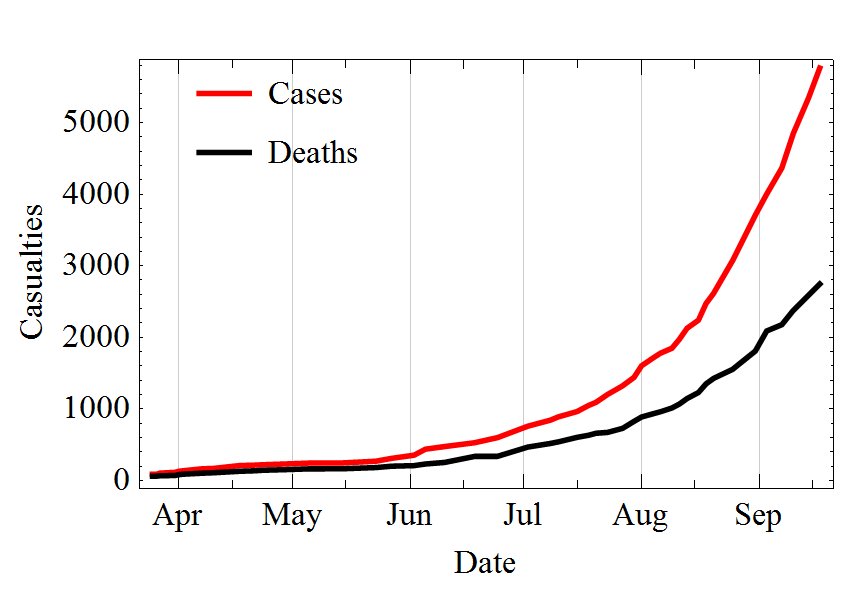
Ebola outbreak is heading toward 20,000 cases by November

The current West African Ebola outbreak is big, tragic, and exceedingly dangerous.  Current trends point to 20,000 infected patients by November.

Martin Leopoldo has been posting the current tally of cases, and it’s not pretty.  This is a big deal, folks.  Let’s hope that the combination of border lockdowns, U.S. (and other) military personnel and field hospitals can head things off.  If not, the world is in for a lot of misery…

Diseased_Ebola_2014


Source: Martin Leopoldo / wikipedia entry.

Posted in Healthcare | Tagged , | Leave a comment

Fortune Cookie Leadership Advice

“A leader is a person you will follow to a place you wouldn’t go by yourself.”

Posted in Management | Leave a comment

Biggest technology leaders limit the tech their kids use

In a New York Times article titled “Steve Jobs Was a Low Tech Parent“, Nick Bilton describes how many technology entrepreneurs actually strictly limit their kids’ access to high tech gadgets.  Soon after the iPad was released, Steve Jobs told Nick that his kids hadn’t yet used the devices, revealing that he limited how much technology the kids used at home.  Nick goes on to say:

Since then, I’ve met a number of technology chief executives and venture capitalists who say similar things: they strictly limit their children’s screen time, often banning all gadgets on school nights, and allocating ascetic time limits on weekends.

I was perplexed by this parenting style. After all, most parents seem to take the opposite approach, letting their children bathe in the glow of tablets, smartphones and computers, day and night.

Yet these tech C.E.O.’s seem to know something that the rest of us don’t.

Chris Anderson, the former editor of Wired and now chief executive of 3D Robotics, a drone maker, has instituted time limits and parental controls on every device in his home. “My kids accuse me and my wife of being fascists and overly concerned about tech, and they say that none of their friends have the same rules,” he said of his five children, 6 to 17. “That’s because we have seen the dangers of technology firsthand. I’ve seen it in myself, I don’t want to see that happen to my kids.”

Indeed, maybe they know something we don’t.

Posted in Information Technology, Learning | Leave a comment

Apple hits it out of the park again

Apple Watch Video

Yes, other companies have been making smart watches and fitness monitors for a while now.  Yes, they will have some advanced features that Apple’s will lack.  Yes, Henry Blodget has called the Apple Watch “irrelevant“.  But — just like with MP3 players, smart phones, and tablets — Apple has integrated design, technology, human interactions, indeed an entire ecosystem, into a product that sets a new standard which everyone else will follow.

Sure, Apple’s new iPhone 6 models will sell more units, and Near Field Communications financial transactions may bring in more revenue than the new watch.  Sure, other manufacturer’s watches will equal or even exceed it in terms of raw capability.  Other manufacturers will sell more devices.  But as a total package the new Apple Watch is in a league all its own.  If it performs even half as well as the propaganda videos claim, they will sell millions of units and continue to collect more than 80% of industry profits.

With the spread of smart watches catalyzed by Apple, we will enter a whole new era of sensor data generation, analysis and sharing that will transform how we think about health, fitness, connectedness, and mobile computing.

The. Best. Consumer. Technology. Company. Ever.

Posted in Information Technology, Innovation | Tagged , | Leave a comment

The New Geography of Innovation

Innovation Districts

A dramatic shift in the geography of innovation is underway, according to a new report authored by Bruce Katz and Julie Wagner of the Brookings Institute, and Kendall Square is the poster child for the paradigm.  Bruce and Tim Row of the Cambridge Innovation Center talked about the phenomena of innovation districts at a recent meetup sponsored by Pfizer Cambridge.

For the past 50 years, much of the landscape of innovation has been dominated by suburban corridors of spatially isolated corporate campuses, accessible only by car, typically removed from housing and recreation.  Corporate and Academic campuses alike were built or expanded in vast open areas far from city centers through much of the 20th century.  That is now changing, with the rise of urban innovation districts.

A new complementary urban model is now emerging, giving rise to what we and others are calling “innovation districts.” These districts, by our definition, are geographic areas where leading-edge anchor institutions and companies cluster and connect with start-ups, business incubators and accelerators. They are also physically compact, transit-accessible, and technically-wired and offer mixed-use housing, office, and retail.

Epitomized in the U.S. by high tech districts in San Francisco, Seattle, Brooklyn, Portland, Chicago and other cities, similar districts are under development around the globe in places like Barcelona, Berlin, London, Medellin, Montral, Seoul, Stockholm, and Toronto.  Perhaps the prime example is Kendall Square in Cambridge Massachusetts, an area roughly 10 city blocks on a side.  Anchored by the Massachusetts Institute of Technology, Kendall Square is home to over 150 high tech institutions.  According to Tim Row, the neighborhood is home to approximately 5% of all global venture capital funding (the U.S. totals 80% of global VC funding, Massachusetts 16%).  Despite incredible growth in telecommunications and online networking, face to face human interactions are still incredibly powerful, and Boston is working on a second innovation district along the South Boston waterfront.

Innovation districts are the manifestation of mega-trends altering the location preferences of people and firms and, in the process, re-conceiving the very link between economy shaping, place making and social networking.  Our most creative institutions, firms and workers crave proximity so that ideas and knowledge can be transferred more quickly and seamlessly. Our “open innovation” economy rewards collaboration, transforming how buildings and entire districts are designed and spatially arrayed. Our diverse population demands more and better choices of where to live, work and play, fueling demand for more walkable neighborhoods where housing, jobs and amenities intermix.

Interestingly, some well known suburban high tech areas, such as North Carolina’s Research Triangle Park, are actually re-urbanizing — building bike paths, bringing new residential and retail development into the suburban campus.  So what’s the big deal?  In a word, jobs.  Estimates are that five additional jobs are created for every new high tech job in an innovation district.  Innovative cities and innovative nations are more prosperous than non-innovative ones.  Many think that innovation districts will be centers of job creation and economic dynamism with large spillover effects for much of the 21st century.  Is the idea just the latest fad in urban planning?  Possibly.  But the concept is driving a LOT of development around the world, and for the next several decades it will shape many urban environments.  To learn more, you can read the online report, or watch one of Bruce’s presentations.

Posted in Boston-Cambridge, Innovation | Tagged , , , | 1 Comment