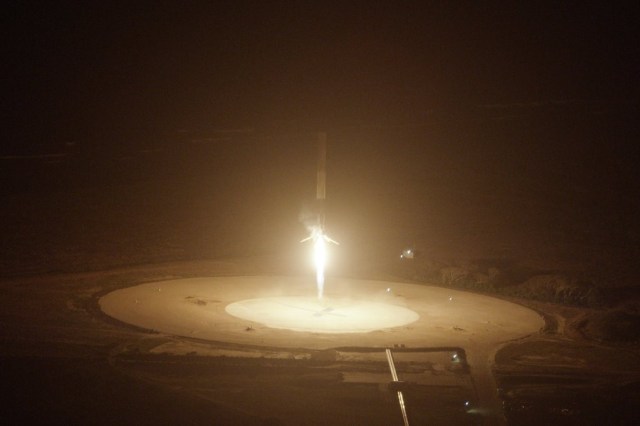
SpaceX sticks the landing

Dragon9landing1 Dragon9landing2

SpaceX Dragon 9 booster lands safely on an autonomous floating platform, after launching a payload into space.

Potentially a 10-fold reduction versus current launch costs.  Game.  Changer.

Video at: https://youtu.be/sh8V0COrrzE?t=2129

And Blue Origin isn’t far behind.

Update: The payload was the inflatable Bigalow space capsule, scheduled to be deployed on the International Space Station for two years of testing.  Another potential game changer.

Posted in Innovation, Space & Astronomy | Tagged , | Leave a comment

Florence Nightingale was a data scientist

800px-Florence_Nightingale_three_quarter_length

Everyone knows Florence Nightingale as a dedicated and courageous caregiver, the founder of modern nursing.  But she was also quite a good statistician.    In 1850’s, while she served at the British military hospitals in Turkey, she instituted rigorous data collection and analysis for medical records.  She collected new types of data, filling notebooks with tables and graphs.  In fact, she popularized a kind of infographic, the “coxcomb” chart (essentially polar area plots).  Because of her data analysis, she was able to demonstrate seasonal trends in mortality and illustrate the large fraction of preventable deaths caused by disease — supporting the idea that poor sanitary conditions were the main cause of hospital deaths.  In fact, in 1859, Florence Nightingale was elected the first female member of the Royal Statistical Society.

1280px-Nightingale-mortality


Posted in Data Analysis, Fun Science | Tagged , | Leave a comment

Liam – Apple’s Robotic System for Recycling iPhones

One of the more interesting topics this week at Apple’s product event was the introduction of Liam, a robotic system for disassembly of iPhones:

Liam

Click here for a cool YouTube movie.

When an iPhone is finally discarded, Liam detects, disassembles, and separate parts for recycling. Cobalt and lithium are recovered from the battery, gold and copper from the camera, platinum and silver from the main logic board, etc.  Check out apple/recycling for more information.

Makes you wonder how far automated assembly of iPhones has progressed…

Update:  Mashable has a detailed article about Liam.  The full system is about as big as a medium-sized warehouse, has 29 different arms, and can process around 11 million iPhone 6S devices a year.  Apple is continuing to fund significant R&D in automated recycling — apparently controlled disassembly makes it much easier to recycle the materials compared to conventional “shred-and-separate” methods.

Posted in Apple, Automation, Innovation | Tagged , , | Leave a comment

6% of companies make 50% of U.S. profit

From an analysis done by USA Today: Just 28 companies in the S&P 500 index generate 50% of all the net income. Of those, Apple and JPMorgan Chase together make 10% of the profits. Berkshire Hathaway, Wells Fargo, Gilead Sciences and Verizon round out another 10%. That’s one fifth of total profits from only six companies.

Think about that for a moment. If you believe profits drive stock market value, that means the overall returns of large scale investments such as 401k’s and pension plans have to be driven by these large cap stocks — because that’s where the profits are. Taken as a whole, there aren’t enough profits in small caps for everyone’s investments to do well. Another strong argument for market cap weighting, it seems to me.

Here’s a chart from the article:


Posted in Economics, Investing | Tagged , , , | Leave a comment

Massive 2016 Snowstorm Seen from Space

CZZyRukUgAA6Oge

As #blizzard2016 passes over #Chicago, the #EastCoast seen in distance clearly has a long way to go. #YearInSpacepic.twitter.com/qMrkTXo9ie

— Scott Kelly (@StationCDRKelly) January 23, 2016


Posted in Fun Science, Space & Astronomy | Leave a comment

A comeback for incandescent light bulbs as MIT makes them more efficient than LEDs

New bulb technology

Researchers at MIT have demonstrated a new kind of incandescent light bulb which uses nanocrystal structures surrounding the filament to bounce heat back and re-emit the energy as light.  The new technology would allow incandescent light bulbs to be more efficient and cheaper than LEDs and compact fluorescent bulbs, while at the same time eliminating the need for toxic materials and bringing back faithful color rendering to boot.  Very cool.  Check out MIT News for the details.

Posted in Innovation | Tagged , , | Leave a comment

Collaboration overload is degrading our organizations

Harvard Business Review has a must-read article on a phenomena that some of us have already started to notice:  Too much collaboration degrades an organization’s ability to get work done.  The rise of matrix organizational schemes, dual reporting structures, and the large amount of necessary teamwork that comes with complex projects means a deluge of emails and meeting requests.  And the amount of communication required scales up dramatically with the increase in folks who need to be consulted or informed.

According to data we have collected over the past two decades, the time spent by managers and employees in collaborative activities has ballooned by 50% or more.

Certainly, we find much to applaud in these developments. However, when consumption of a valuable resource spikes that dramatically, it should also give us pause. Consider a typical week in your own organization. How much time do people spend in meetings, on the phone, and responding to e-mails? At many companies the proportion hovers around 80%, leaving employees little time for all the critical work they must complete on their own. Performance suffers as they are buried under an avalanche of requests for input or advice, access to resources, or attendance at a meeting. They take assignments home, and soon, according to a large body of evidence on stress, burnout and turnover become real risks.

In biomedical research the problem is particularly acute because scientists need big continuous blocks of time to get their lab work done — anything from 2-3 hours up to a full day of time spent in the lab might be required.  Toss a few high priority or mandatory meetings into the mix and you might block a whole day of work.  One subtle degradation I’ve seen in the last 10-15 years is the loss of “two experiment” days. More than a decade ago I remember bench researchers routinely doing an experiment in the morning, the results of which drove a second follow up experiment executed in the afternoon.  I rarely see that now.  Today one experiment with associated data analysis and electronic notebook entry creation seems to be all that can be squeezed into a typical work day.

But here’s the worse thing of all: the collaboration burden falls most heavily on top performers who get deluged with requests for help.  Many of the best workers are eager to assist, and will spend significant time helping someone else.  But that takes away from time to work on their own projects.  And help doesn’t count at the end of the year as much as making milestones.  In the worst case scenario, the best performers spend too much time getting too little credit, their own work slows, they get burned out, and they quit.

What’s more, research we’ve done across more than 300 organizations shows that the distribution of collaborative work is often extremely lopsided. In most cases, 20% to 35% of value-added collaborations come from only 3% to 5% of employees. As people become known for being both capable and willing to help, they are drawn into projects and roles of growing importance. Their giving mindset and desire to help others quickly enhances their performance and reputation. As a recent study led by Ning Li, of the University of Iowa, shows, a single “extra miler”—an employee who frequently contributes beyond the scope of his or her role—can drive team performance more than all the other members combined.

Unfortunately, there is a destructive feedback loop:

But this “escalating citizenship,” as the University of Oklahoma professor Mark Bolino calls it, only further fuels the demands placed on top collaborators. We find that what starts as a virtuous cycle soon turns vicious. Soon helpful employees become institutional bottlenecks: Work doesn’t progress until they’ve weighed in. Worse, they are so overtaxed that they’re no longer personally effective. And more often than not, the volume and diversity of work they do to benefit others goes unnoticed, because the requests are coming from other units, varied offices, or even multiple companies. In fact, when we use network analysis to identify the strongest collaborators in organizations, leaders are typically surprised by at least half the names on their lists. In our quest to reap the rewards of collaboration, we have inadvertently created open markets for it without recognizing the costs.

The authors have some suggestions to help control the situation, most notably:

  • Focus on efficient activities like sharing information and social awareness, rather than expending precious work time.
  • Reward good collaborators, not just high individual performers.
  • Take a hard look at recurring meetings, team rosters and distribution lists.  Make sure they’re adding value.

Read the whole thing.


Posted in Management | Tagged , | Leave a comment

SpaceX makes history by launching, then landing rocket booster

elonmusk1-640x426

Long exposure photograph of the launch followed by the booster landing.  What goes up must come down — in one piece, in this case.

A new age of space exploration dawns as SpaceX has for the first time landed a first stage rocket booster used on an orbital mission.

CWzUJbpUkAEBOtD

Booster landing

Some estimate that launch costs can be reduced 10 or even 100-fold if boosters — and their expensive engines — can be reliably returned rather than destroyed with each mission.  The fuel itself is a small fraction of the launch cost.

While Jeff Bezos’ Blue Origin also landed a sub orbital rocket recently after a short flight, the SpaceX booster was part of an actual orbital mission and hit Mach 7.5.  It also flew hundreds of kilometers away before it returned under its own power to the same launch pad.  Game.  Changer.  Arstechnica has complete details.


Posted in Innovation, Space & Astronomy | Tagged | Leave a comment

Teleconferences — the mute button is on, and people are off doing yoga or the laundry

“Much of what we call work is noise” – Nassim Taleb

Here’s the latest example of that, from the New York Times:  The Modern Meeting: Call In, Turn Off, Tune Out.  Backed by personal observation, data from consulting firms, and tons of anecdotal evidence, it’s clear that a large fraction of attendance at the all-too-ubiquitous teleconference is a complete and total waste of time.

Wainhouse Research, a consulting firm in Duxbury, Mass., estimates that a knowledge worker — one whose job focuses on handling information — in the United States spends an average of 104 minutes each month in conference calls. Such calls have become an orgy of multitasking, serving as a backdrop for a free-for-all of household chores, personal hygiene, online shopping and last-minute income tax filing. As a result, conference calls give rise to what could well be society’s most widespread, implicitly sanctioned collection of antisocial behaviors.

As one of the interviewees points out, there are two basic types of conference call.  First, the meeting in which you are a leader or a significant contributor.  Second, the type of meeting in which you are there for political reasons, to make sure nothing goes wrong, or just to stay in the loop.  In the latter type of meeting, more and more people are just not paying attention.  They are off doing yoga or laundry or — very commonly — reading emails.  In general, not listening.  So why attend?  Indeed, why invite such spectators?  It would be much more efficient to post meeting minutes on an internal wiki page and invite comments for a set period.  Perhaps a lot of non-value added conference call attendance is a sign that your company’s internal communication mechanisms are weak.

Posted in Management | Tagged , | Leave a comment

New Horizons spacecraft spots a wandering Kuiper Belt object

Spotting a KBO: New Horizons image of 1994 JR1, taken Nov. 2, is the closest-ever picture of a Kuiper Belt object. (Credit: NASA/JHUAPL/SwRI)

As the New Horizons space craft heads out through the Kuiper Belt at the outer reaches of the solar system, it will be able to capture images of these mysterious objects more detailed than anything previously seen.  In the four frame time series above, a far away KBO is seen moving across the star field.

Meanwhile, New Horizons continues to stream previously collected data from Pluto back to NASA, including some of the most detailed surface pictures yet.  The landscape includes water ice blocks jumbled up against smoother areas, eroded areas of canyons and cliffs, and icy plains dotted with craters.

MountainousShorline   CratersandPlains

Dig around the New Horizons home page for complete details and many more images.

Posted in Space & Astronomy | Leave a comment